Author: Jeff Moore

  • ECOLOGY OF THE GREEN DRAGON

    ECOLOGY OF THE GREEN DRAGON

    A Treatise on Toxic Verdancy, Nitrogen Breath, and the Forest Apex Predator

    Introduction

    Among the chromatic greatwyrms, none shape their environment so subtly—or so ruthlessly—as the Green Dragon. Though often dismissed as mere tyrants of deep forests, they are in truth architects of a chemical dominion, cultivating their territories with methods far more refined (and insidious) than simple tooth and claw.

    This article explores the biological foundations of the Green Dragon: its diet, its influence over the nitrogen cycle, the genesis of its infamous choking breath, and the ecological consequences of its reign.

    I. The Green Dragon as a Preferential Carnivore

    Despite their lair’s position deep within wooded biomes, Green Dragons are not herbivores grazing in disguise. Their diets consist primarily of:

    • deer, elk, aurochs, and boar
    • bears, wolves, and predatory competition
    • the occasional giant or humanoid carrion from slain intruders
    • chitinous megafauna such as ankhegs or giant beetles

    This high-protein diet supplies the wyrm with the vast quantities of reactive nitrogen required for its unique physiology. Unlike herbivores, which struggle to extract nitrogen from plant matter, a dragon’s digestion destroys proteins and nucleic acids wholesale, releasing free nitrogen compounds in prodigious quantities.

    These nutrients do not merely sustain the dragon: they power its signature weapon.

    II. The Nitric Furnace: Internal Generation of Toxic Breath

    A. The Verdancy Sacs

    Deep within the dragon’s thorax lie paired organs known to anatomists as Verdancy Sacs. Functionally intermediate between liver, gland, and chemical reactor, these sacs accumulate:

    • nitrites (NO₂⁻)
    • nitrates (NO₃⁻)
    • dissolved nitric oxide (NO) trace ammonia and amines

    These molecules are metabolic byproducts of the dragon’s prodigious carnivory and the breakdown of protein-rich prey.

    B. Oxidation Chambers

    Adjacent to the Verdancy Sacs lie smaller, hotter cavities lined with richly vascularized tissue. When the dragon contracts specific thoracic muscles, fluids from the Verdancy Sacs atomize into these Oxidation Chambers, where:

    • Internal heat volatilizes the solution.
    • Oxygen-rich airflow contacts the vapor.
    • Nitric oxide (NO) oxidizes rapidly into nitrogen dioxide (NO₂).
    • The mixture becomes a dense cloud of brown, choking fume.

    C. The “Deep Sneeze” Delivery

    To expel the gas, a Green Dragon performs an explosive contraction of its thoracic diaphragm, not unlike an immense, controlled sneeze. The result is:

    • a jet of corrosive NO₂
    • dense as a winter fog
    • heavier than air clinging to the forest floor

    The fumes react instantly with moisture, forming nitric and nitrous acids. These acids blister flesh, burn lungs, and suffocate those caught within the cloud.

    A Green Dragon’s breath weapon is essentially a biologically generated nitrogen-oxide aerosol.

    III. A Cycle of Death and Growth: The Dragon’s Nitrogen Ecology

    It is a mistake to view the dragon’s breath as mere weaponry. It is also a tool of land management—albeit a brutal one.

    Green Dragons practice environmental manipulation unique from other wyrms using a Nitrogen Enrichment Cycle.

    Step 1: The Kill

    The dragon slays intruders, game, or rival predators. This serves two purposes:

    It obtains high-nitrogen flesh for its metabolism. The territory is cleared of dangerous or competing fauna.

    Carcasses are often half-eaten and left scattered across the forest.

    Step 2: Decay and Enrichment

    As these remains decompose, nitrogen-rich compounds seep into the soil, jump-starting microbial activity. Forest scavengers—slimes, insects, oozes—accelerate the process.

    This creates hotspots of nutrient density in the dragon’s domain.

    Step 3: Breath Deposition

    At intervals, the dragon unleashes its breath across select stretches of forest floor. If the concentration is high, it serves as a deterrent; if low, the NO₂ is allowed to settle and react:

    NO₂ + moisture → HNO₂ + HNO₃ Acids neutralize into nitrates, a potent fertilizer.

    Moderate doses cause foliage to wilt briefly before rebounding with intense vigor.

    Step 4: Bloom Phase (1–7 Days)

    Where the fumes settle, the forest undergoes sudden transformation:

    grasses lengthen brambles multiply invasive vines race across the undergrowth moss and fungi erupt in patches saplings grow unnaturally green and flexible

    This “verdant swell” is the dragon’s hallmark: a territory that appears lush, yet subtly malignant.

    Step 5: The Trap-Beast Stage

    The dragon’s favored prey—deer, boar, even humanoids—are drawn to these newly enriched growths. Grazers seek fresh shoots; hunters seek grazers.

    The dragon allows this micro-ecosystem to build until it becomes a living snare. At the peak of density, the dragon:

    descends from above unleashes controlled breath attacks harvests the converging fauna

    And the cycle begins anew.

    IV. Defensive Biology: The Green Dragon’s Immunities

    A natural question arises: How does the dragon withstand its own toxic fumes?

    A. Specialized Respiratory Tissue

    Their lungs are lined with acid-resistant mucosa similar to the tissues found in certain oozes.

    B. Modified Hemoglobin

    Green Dragon blood uses an iron-magnesium hybrid heme structure, making it less reactive with nitrogen oxides and preventing NO₂-induced suffocation.

    C. Olfactory Shutdown Reflex

    Exposure to a dragon’s own fumes triggers a neurological dampening of its smell receptors, allowing the creature to move through its own smoke unhindered.

    D. Corrosive-Resistant Scales

    The emerald hue of Green Dragon scales is due in part to selenium-based pigments and nitrogen-reactive oils, which neutralize trace acids on contact.

    V. The Dragon-Tended Forest: Signs of Their Dominion

    A ranger traveling through green dragon territory may notice:

    • zones of sudden, unnatural overgrowth patches of burned or acid-scorched brush amid healthy greenery
    • accelerated fungal blooms
    • absence of large predators (killed or fled)
    • prey animals congregating at nitrate-rich clearings
    • a faint, acrid tang in the air after thunderstorms

    Thunderstorms, incidentally, produce their own nitrogen oxides. Dragons appear to delight in flying through lightning storms—perhaps to “refresh” their glands.

    VI. Lair Architecture and Chemical Hazards

    Green Dragons often choose lairs where atmospheric conditions help their breath weapon:

    • deep forest ravines
    • hollows with perpetual mist bogs with high humidity
    • jungles with dense understory

    Humidity enhances the conversion of NO₂ into acids, increasing lethality.

    Some dragons even cultivate pools or cisterns where vapors collect.

    Travelers report brownish-yellow fog banks lingering unnaturally near some lair entrances—a warning of chemical traps laid by an ancient master.

    VII. Behavior of the Breath Weapon in Combat

    Scholars observe that Green Dragons rarely use their breath as a simple jet. Instead:

    • they saturate an area
    • let the gas settle downward
    • then maneuver above their prey forcing foes to either flee through more fumes or suffocate where they stand

    This tactic exemplifies the green’s personality—patient, manipulative, and always in control of its terrain.

    Conclusion

    The Green Dragon is not merely a forest tyrant. It is a biochemical sovereign, using its own metabolism, its prey, and the chemistry of the forest itself to maintain a deadly, self-sustaining ecosystem.

    Where a Green Dragon dwells, the forest grows thick and vibrant—but always under a pall of danger. Every rust-colored haze, every patch of sudden verdancy, every strangely lush glen is a testament to the dragon’s presence.

    Life flourishes where death is abundant.

    And in the shadows of that cycle, the Green Dragon rules supreme.
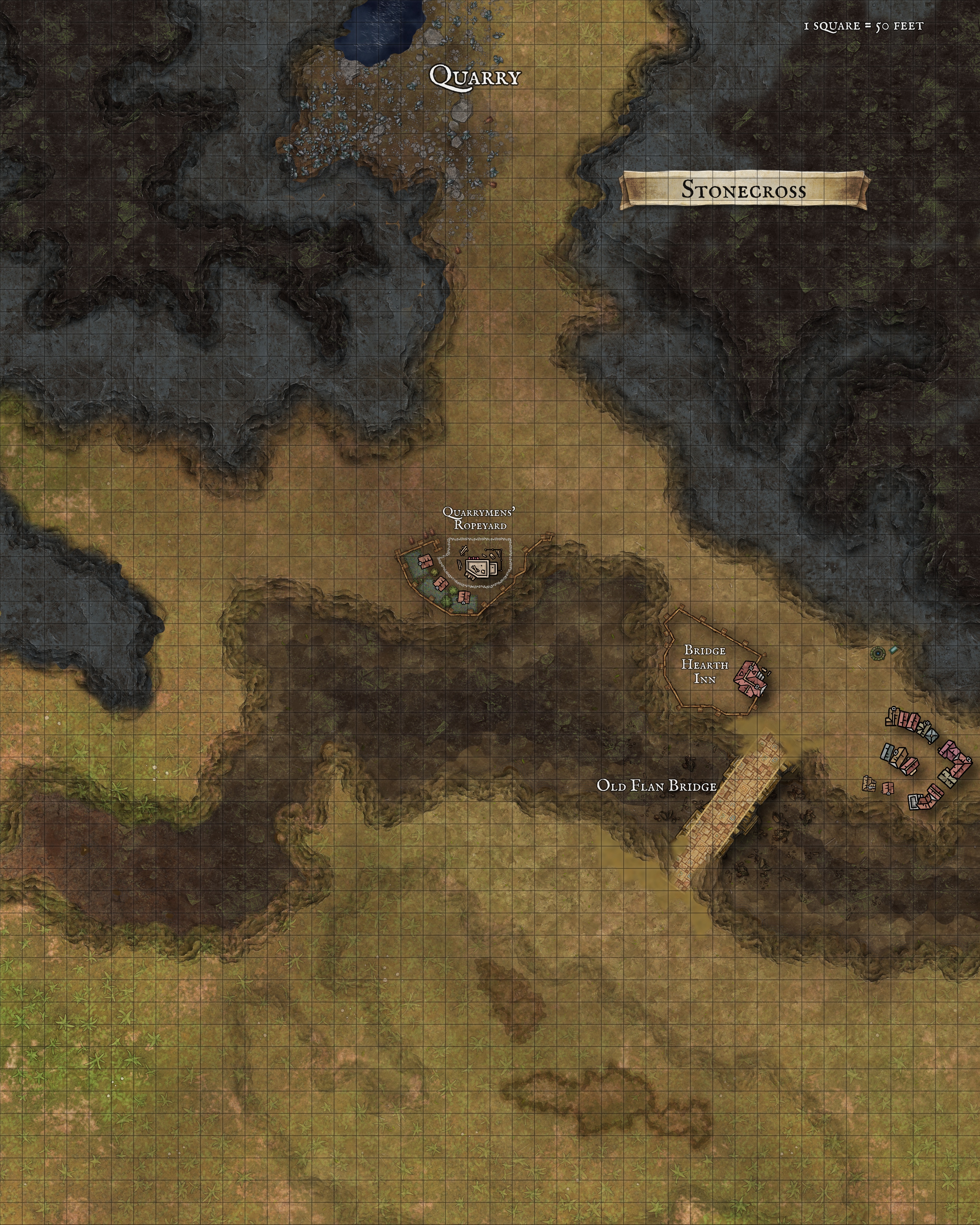
  • Stonecross (Hamlet)

    Population: ~60 (80% Human – mostly Flan, 10% Dwarf, 10% Halfling)

    Primary Trades: Quarrying, stonecutting, masonry, and ropework for mining & bridge maintenance

    Overview

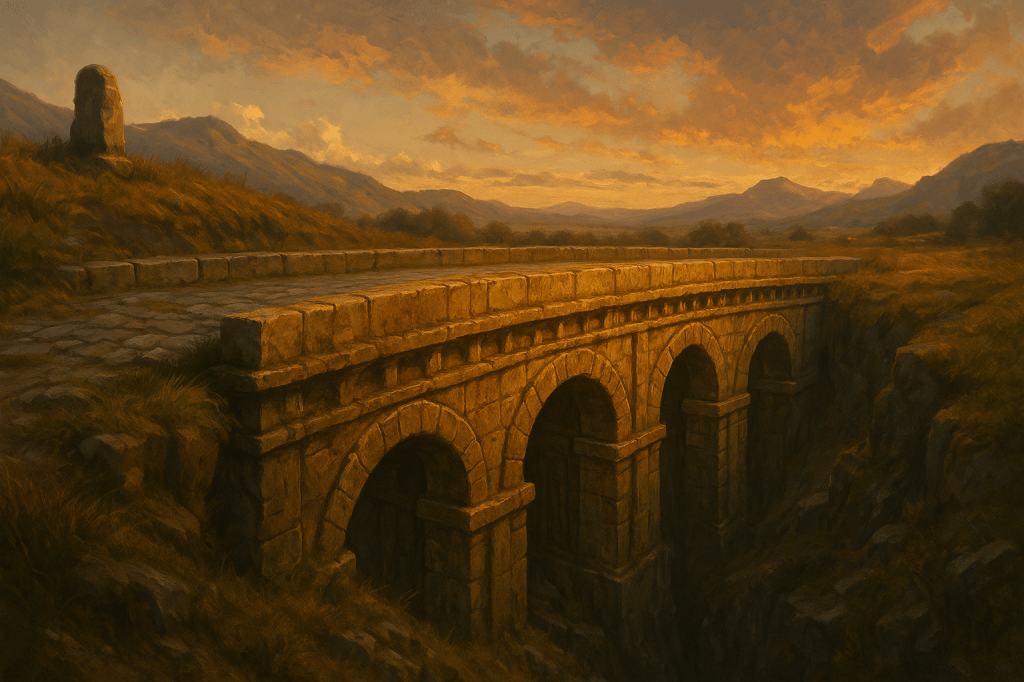
    Stonecross takes its name from the ancient Flan bridge that spans the ravine just south of town — a single, perfectly balanced arch of mottled stone that has weathered centuries of flood and frost. Locals claim it was built by “hands older than dwarves,” and many refuse to cross it after dark, whispering that the bridge hums faintly when storms approach.

    The hamlet clings to the narrow shelf of land beside the ravine, its homes built from the same cold gray limestone they quarry. The air forever tastes faintly of dust and river spray. Though small, Stonecross’s industry and tenacity make it one of the most reliable stone sources in northern Wolfsward — and one of the most superstitious.

    Beyond the quarry’s rim lie the foothills of the Griffs, where scattered Ur-Flan ruins and dwarf-like masonry fragments have been unearthed. Giant sightings, though rare, have been reported in the high passes. Kobolds, gnolls, and hobgoblins roam farther north, drawn to the abandoned shafts and caves.

    Places to Go

    🕯 The Bridge Hearth (Tavern & Common Hall)

    A sturdy stone tavern with a single long communal table at its heart. Quarrymen, masons, and surveyors share ale and stories shoulder to shoulder. The hearth itself is built from a slab taken from the ancient bridge — a fact that some consider a blessing, and others, a curse.

    Proprietor: Grena Barhold, broad-shouldered Flan matron with a booming laugh and zero patience for superstition—at least when customers are paying. Menu Highlights: Quarryman’s stew (river trout and root vegetables), ashbread (baked with lime-dusted flour), and “Bridge Ale,” brewed with springwater drawn from beneath the ravine. Rumor Board: Sightings of lights beneath the bridge, miners hearing knocking from below the quarry, and a halfling surveyor who swears the bridge’s span “shifted” one inch last spring.

    ⚒ Quarryman’s Store & Ropeyard

    Across from the tavern sits the supply depot run by Varn Droskin, a patient, stone-faced dwarf who once mined under the Griff range. His missing thumb and dry humor are local legends. The store provides chisels, pitch, wagon chains, and climbing rope — much of it crafted and tested by the halfling surveyors.

    A fenced yard out back is strung with thick hemp ropes and pulleys used for testing knots and harnesses before they’re lowered into the quarry.

    ⛏ The Old Quarry

    A half-flooded pit north of town, its surface water still and black. Quarry crews avoid the lower shelf since a collapse two winters ago swallowed a cart and three workers. Strange ripples have been seen on still days, and the local druid swears the rock “weeps at night.”

    The Flan Bridge

    A marvel and a mystery — built long before the Duchy of Tenh. Faint spiral carvings along its stones evoke eyes and flowing waves. Druids of Beory warn that it was raised not for mortals but against something ancient that once crossed here.

    Crossing it without leaving a coin or chip of stone is said to bring bad luck, and even the dwarves mutter a quick blessing before stepping onto its span.

    People to See

    Grena Barhold, Innkeeper of The Bridge Hearth — boisterous, tough, fiercely loyal to her patrons. Keeps miners and masons from coming to blows. Varn Droskin, Dwarf quarry master — keeps precise records of every cut stone and every man lost to the pit. Quietly despises superstition but listens carefully to halfling reports about cracks or stress shifts. Ellar Fenmoor, Flan shepherd and local storyteller — claims to have seen “stone men walking the ridges.” Half the town believes him. Lira of the Glen, young druidess from Reedwatch — advocates for sustainable quarrying and communes with the spirits of the rock. Perrit “Tangleline” Underbough, halfling ropewright and lead surveyor — agile, witty, and fearless. Known for crawling into crevices no one else dares. She’s saved more than one miner with her quick rigging and carries a silver chisel she claims “keeps the dark from whispering too loud.”

    Halflings of Stonecross

    The halflings here are unlike their kin in the meadows. Calling themselves the Tangleline Guild, they serve as surveyors, ropewrights, and pit-climbers, their small size and steady nerves ideal for navigating narrow shafts and hanging over cliff faces.

    They’re respected by dwarves and Flan alike for their professionalism — though humans joke they have “stones in their heads for wanting to live up walls.” In truth, without them, the quarry would have closed years ago.

  • Riverbend

    Exports: Smoked fish, river reeds, clay jugs, ferry timber, and dock rope.

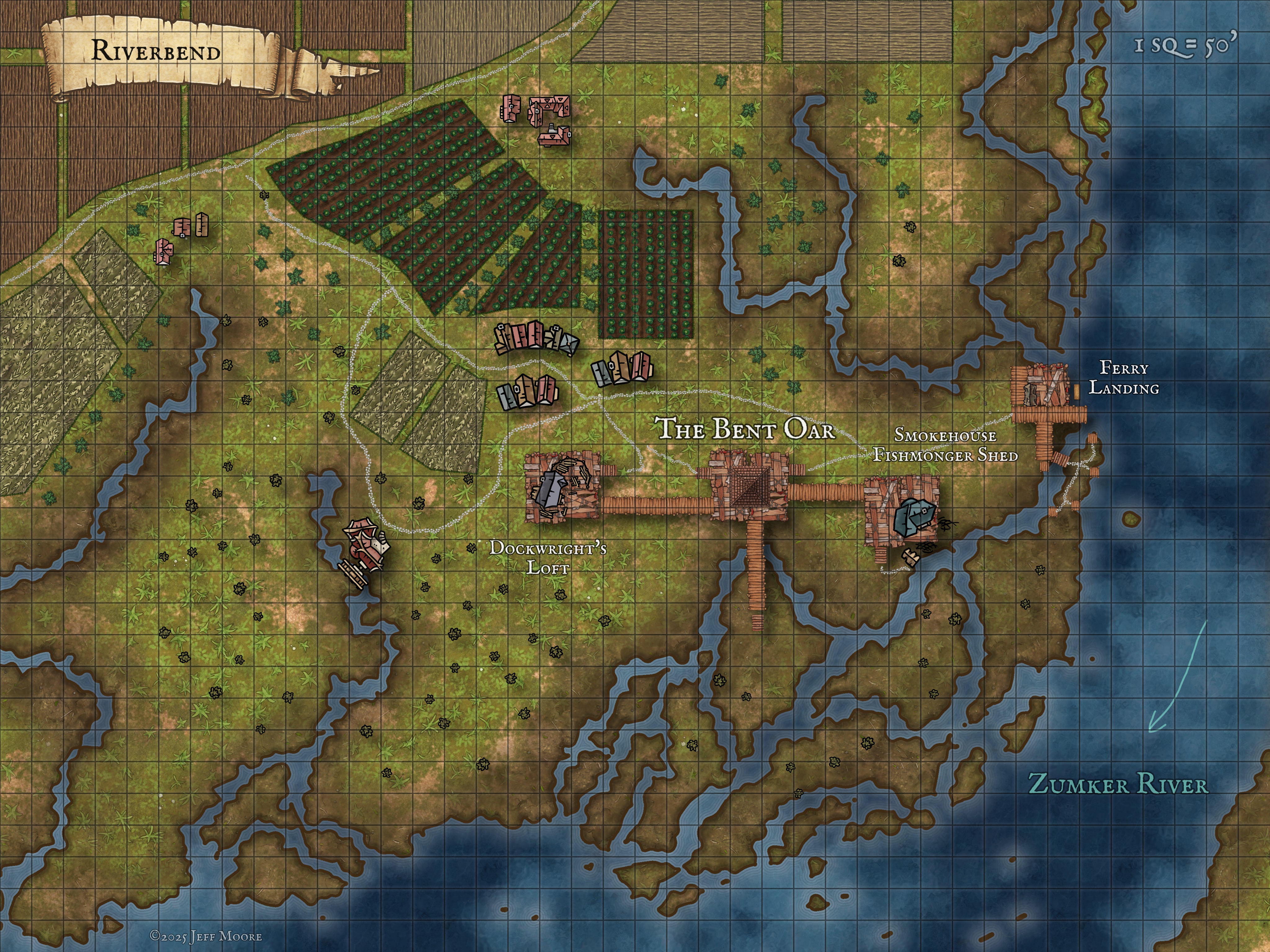
    Location: On the inner curve of the Zumkend River where it bends sharply south before turning east again. The hamlet clings to the bank on stilted foundations, its planked walks connecting homes, storehouses, and the small dockyard.

    Atmosphere: Always humming with motion — poles knocking against boats, gulls wheeling above the water, and the smell of pitch, fish oil, and riverweed. Locals speak loudly to be heard over the current. Evenings bring music and laughter drifting from the tavern.

    Notable Trait: A loud, lively dock where gossip floats faster than boats. Bargemen, traders, and ferrymen swap tales of storms, barge tolls, and the latest upriver prices.

    Places to Go

    The Bent Oar
    Dockside tavern and common hall.

    • A single-room structure of timber beams blackened by smoke.
    • Nets hang drying near the hearth where locals mend them between drinks.
    • Travelers find stew bubbling with smoked trout and river onions.
    • A small loft above serves as modest lodging for passing crews.

    The Smokehouse & Fishmonger’s Shed

    • Run by Old Harra Wain, a tough woman with river-creased skin and a sharp wit.
    • Handles all salting and smoking for trade goods bound downstream.
    • Barrels of dried trout and eel are stacked in cool pits behind the shop.

    The Ferry Landing

    • Two broad rafts lashed together form the town’s ferry, poled by Bram Two-Poles, who claims to know the river’s moods better than his own wife.
    • The landing doubles as a market square by midday, selling smoked meats, clay mugs, and reed-woven mats.

    The Dockwright’s Loft

    • Shared workshop where human carpenters and halfling ropemakers work side by side repairing boats and barrels.
    • A weather-vane carved like a trout marks the tallest roof in town.

    Local Flavor

    • Signature Drink: “River’s Turn” — a tart ale spiced with marsh-mint and aged in oak barrels.
    • Common Rumor: Bargemen whisper of ghostly lights beneath the bend on moonless nights — said to be drowned miners from upriver.
    • Seasonal Event: The Reed Fair at midsummer, when villagers decorate poles and boats with bright ribbons, racing the current for luck.
  • Redvale (WH1)

    • Population: ~75
    • Demographics: 70% Human (mostly Flan), 20% Dwarf, 10% Gnome
    • Exports: Iron ore, panned platinum flecks, clay pottery, coarse glass trinkets, smoked trout.
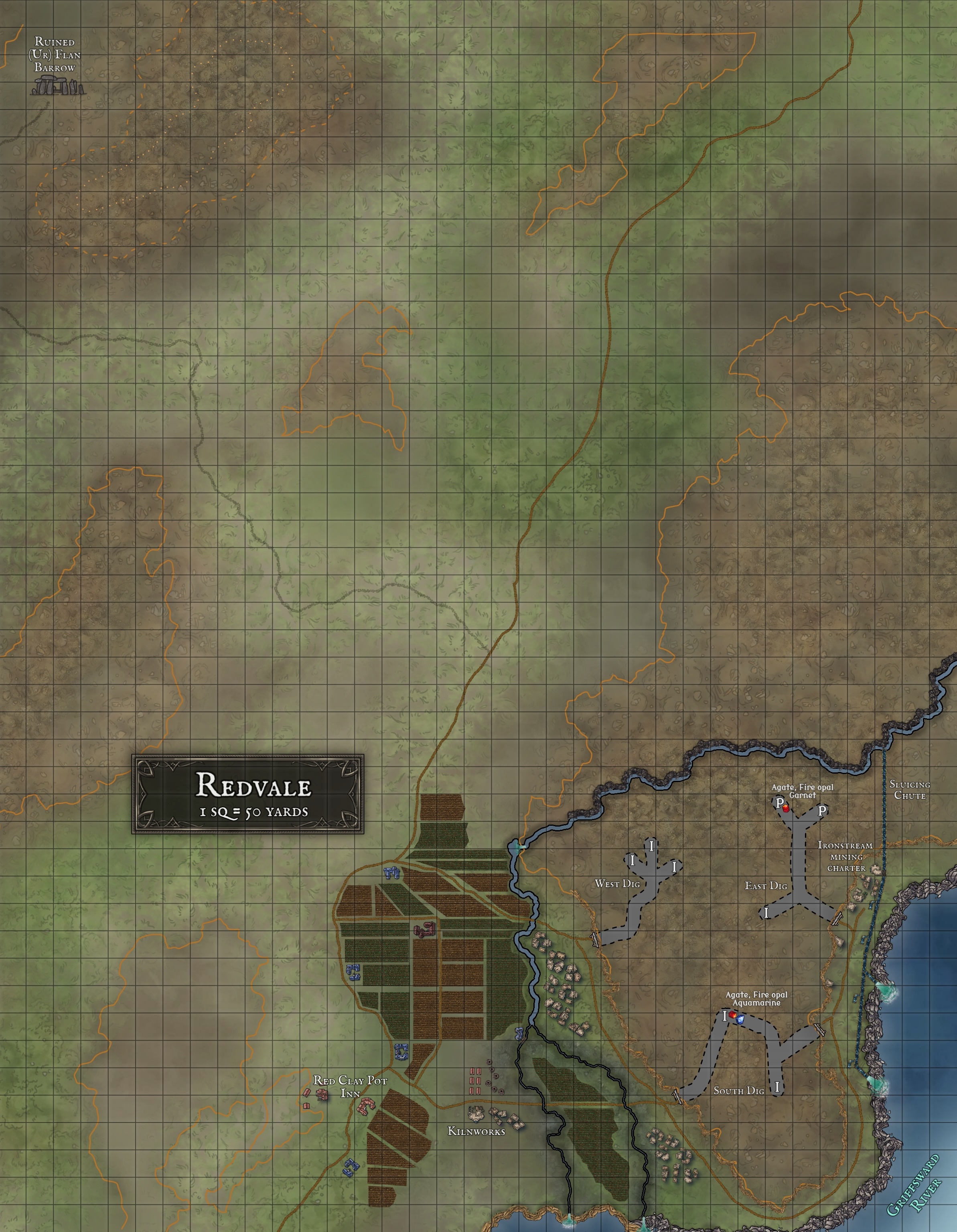
    • Location: Northern Wolfsward, nestled between cliff-like western hills and the Griffsward River to the east.
    • Atmosphere: The air smells faintly metallic and damp. The hills glow rust-red at dusk. Evenings are quiet but for the rhythmic ring of picks and the low moan of the wind through the river gorges. Locals tend to be terse, slow to trust, and wary of outsiders.
    • Nearby Landmark: The Ruined (Ur)Flan Barrow — a grassy mound of stone slabs and runic pillars about a mile north. Locals claim strange lights flicker there on storm nights.
    • Fishing: Cold, fast-moving waters of the Griffsward make it trout territory — hardy river trout (not salmon) that run seasonally in spring and autumn.

    Places to Go

    The Red Clay Pot

    Half tavern, half pottery gallery.

    Built into the side of a red clay hill, its walls glow from kiln heat even in the cold months. Shelves display rustic redware mugs and ceramic charms. The tavern’s specialty is sour wine in red mugs, served with trout cakes and flatbread dusted with mineral salt. Owner: Tibbin Smeltspark (Gnome artisan), who runs the adjoining kilnworks. Secret: The kiln vent connects to a narrow crawlspace leading to forgotten mine shafts — once used by smugglers.

    Kilnworks & Potter’s Guildhouse

    Workshop beside the tavern, filled with steam, clay dust, and racks of fired ware.

    Tibbin’s apprentices experiment with green-tinted glass, trying to blend river silica with local fluxes. They’ve produced rough translucent panes — the first crude glass in the province. Mishaps are common; explosions sometimes rattle the hillside.

    The Ironstream Claim

    A water-driven mining chute system on the riverbank.

    Locals pan for gold and platinum flecks using sluice boxes and rotating troughs driven by river wheels. Rumor says a crew found a “white vein” (platinum) upriver, but one miner vanished after exploring a flooded shaft.

    The Shrine of the Vale

    A modest open-air shrine of weathered stones dedicated to Beory and St. Cuthbert, tended by the town’s healer.

    Offerings of clay idols and river shells line the altar. A large cracked stone slab nearby bears a faint spiral engraving — ancient Flan origin.

    The Barrow Road

    A narrow path leading north between the cliffs toward the Ruined Barrow.

    At dusk, travelers report hearing soft chanting or the hum of wind that sounds almost like singing. Some claim to have seen a pale figure watching from atop the mound. The barrow is believed to house the remains of an ancient Flan chieftain and his “stone choir” — petrified retainers sealed upright in the earth.

    People to See

    • Tibbin Smeltspark, Gnome Potter & Tavernkeeper
      • Neutral Good, Rock Gnome Commoner (Expert)
      • AC: 12 | HP: 18 (4d8) | Speed: 25 ft Skills: Arcana +4, Investigation +3, Artisan’s Tools (Potter) +6 Traits: Inquisitive, excitable, always covered in clay dust. Obsessed with finding the right silica ratio for “clear glass.” Quirk: Talks to his kiln as if it were alive (“Easy now, old Redpot…”).
    • Bram Plaintree, Human Miner Foreman
      • Lawful Neutral, Veteran (simplified)
      • AC: 15 (leather & miner’s plates) | HP: 40 (6d8+12) | Attack: Pick +5 to hit, 1d8+3 piercing Skills: Athletics +5, Perception +4, Survival +3 Traits: Gruff, loyal to his men, distrusts outsiders and tax collectors. Quirk: Keeps a lucky river pebble said to have turned “white with moonlight” the night a kobold raid failed.
    • Yanik Tassum, Dwarf Herbalist & Shrine Keeper
      • Neutral Good, Healer (based on Priest)
      • AC: 13 | HP: 27 (5d8+5) | Spellcasting: (Wis +4, DC 12) Cure Wounds, Bless, Detect Poison, Sanctuary Traits: Calm and maternal but with an iron will; rumored to have faced a bear alone once using a torch and prayers. Quirk: Collects shards of ancient pottery from the fields; believes they hum faintly at night.
    • Faluk Kuusirin, Dwarf Metallurgist Apprentice
      • Chaotic Good, Artificer Apprentice (CR 1/2)
      • AC: 14 (leather & apron) | HP: 22 (5d8) | Attack: Hammer +4 to hit, 1d6+2 bludgeoning Abilities: Once per day can infuse a metal tool to glow for 1 hour or add +1 to damage if weapon. Traits: Fiercely independent, secretly writes letters to Ironridge’s dwarves for trade ideas. Quirk: Wears smoked lenses to protect from kiln glare — makes her look mysterious.

    Additional Locals

    • Orrin Vale: young trapper and scout, wary of wolves in the high slopes.
    • Nalla Greyfen: potter’s apprentice, superstitious, swears she saw “faces in the barrow stone.”
    • Old Dorrik: miner turned drunkard, mutters about “singing from the north cliffs.”

    Things to Do

    • WH1.1 – Song Beneath the Barrow
    • WH1.2 – Vanishing Vein
    • WH1.3 – The Glassfire Kiln
    • WH1.4 – Wolves of Redvale
    • WH1.5 – Giants in the Fog
  • Stonefield (Hamlet)

    Population: ~100 (≈60 dwarves, 30 humans, 10 others including a few gnome journeymen)

    Primary Industry: Platinum mining and ore transport

    Terrain: Rocky foothills below the Spurs of the Skystone and Icerock peaks, along a ravine.

    Founded: ca. 125 years ago under Duke Hadran “the Ironhanded”, in partnership with the Ironspur Dwarves

    Overview

    Stonefield stands as one of the enduring fruits of the Ironhand Compact, the accord forged between Duke Hadran “the Ironhanded” and the Ironspur dwarves of the Skystone and Icerock spurs in the Griff Mountains. The compact, sealed in CY 449, guaranteed dwarves the right of first delve into Tenh’s northern hills and a 50/50 partnership in all precious ore recovered.

    A century later, dwarven surveyors rediscovered rich alluvial and deep rock platinum veins along the Wolfsward slopes and staked a new claim — founding the hamlet that became Stonefield. It is now a rugged frontier community of miners, stonecutters, and haulers, where human families labor beside dwarves under the enduring promise of the Ironhand Compact. Though small, the settlement hums with industry, fairness, and quiet pride — a symbol of Tenh’s earliest alliances between human and dwarf.

    Places to Go

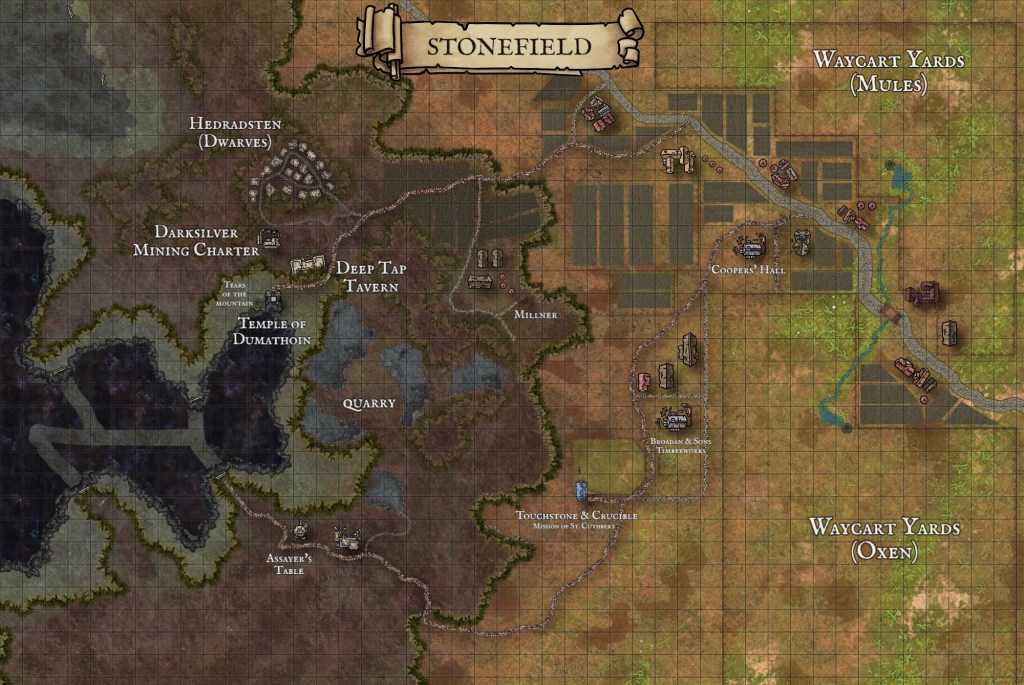
    1. The Deep Tap Tavern

    A stone-built tavern half buried in the hillside, with ceilings just high enough for a human to stand comfortably. A roaring hearth and smoked rafters fill the space with warmth and camaraderie.

    Proprietor: Sera Stonebar, dwarf brewer. Specialty: Iron-tap ale and thick mushroom stew. Lore: The foundation stone bears a runic inscription: “By hand and hammer, in good faith.”

    2. The Coopers’ Hall

    A long timber shed that serves as both cooperage and cartwright’s shop.

    Master Cooper: Jemlin Bott, human craftsman from Ironridge. Assistants: A pair of gnome journeymen learning barrel construction and joinery from dwarven plans. Side Work: Reinforced “powder barrels” for controlled blasting in deeper shafts. Motto: “Tight seals, straight boards, fair trades.”

    3. Touchstone & Crucible Mission (Temple of St. Cuthbert)

    A modest stone chapel near the south side of the hills, built of the same grey stone found in the quarries.

    Priest: Brother Harren Vale, human missionary of the New Flan faith. Congregation: A mix of dwarves and humans drawn to his sermons on law, labor, and order. Custom: Each miner leaves their week’s first coin or chip of ore upon the anvil altar, said to echo faintly when given in honesty. Brother Harran is mostly welcomed by the humans but tension arises between the need for farming help and mining where he and the talhund form a council to settle concerns. Harran feels there should be more an emphasis on defense and has written several strongly worded letters to Rutherton to build an outpost to secure the frontier citing concerns of hobgoblins and kobolds. There has been the occasional rumor of a giant sighting and legend of a Wyvern or dragon in the mountains to the north but no one has actually seen it.

    4. Broadan & Sons Timberworks

    The hamlet’s carpentry yard, operated by Tarrin Broadan and his two sons. They source timber from the scrub hills to the south, shaping mine braces, ore sledges, and wagon frames.

    Workshop: Simple log-and-stone structure open to the air for drying. Notable Work: Their braces are stamped with a small iron hammer — a symbol of the Ironhand Compact. Note: The Broadans work closely with dwarven engineers to balance timber supports with stone foundations, blending human practicality and dwarven precision.

    5. Darksilver Charter Mine

    The main shaft of Stonefield, descending roughly 150 feet into layered rock shot with pale platinum.

    Foreman: Durkan Stonebar, Ironspur dwarf. Crew: ~30 miners, divided evenly between human and dwarf. Feature: Gnome-built pulley bells and dwarven winch systems sing in rhythmic counterpoint day and night.

    Hazard: The lowest tunnel, called The Silent Spur, hums faintly when struck — miners avoid it after dark. Tradition: Each season’s end, Durkan recites the Ironhand Compact aloud at the shaft’s mouth — “so the mountain remembers.”

    6. The Assayer’s Table

    A small, thick-walled office beside the mine gate.

    Assayer: Winnet Fross, gnome metallurgist and recordkeeper. Duty: Tallies purity and weight of all ore shipments for both the Duke’s agents and the Ironspur delegation. Observation: Winnet quietly suspects that Stonefield’s platinum is purer than Ironridge’s — a secret she guards in triple-locked ledgers.

    7. Waycart Yards

    The oxen and mule yards comprise over 50 acres of land. Large open air stables house ox used for moving ore, stone and metal south to Ironridge and Rutherton.

    Caretaker: Rugar Nenn, human drover, gruff but dependable. Routine: Rings a bronze bell thrice before dawn — a ritual known as “Hadran’s Handshake,” marking the start of the day’s haul toward Ironridge.

    8. Temple of Dumathoin

    Originally the first mine to break ground over 250 years ago, well before the formal charter, this now serves as a temple to honor Dumathoin and the mining charter.

    The clergy is led by four talhund, all miners or gemologists by trade a century ago, now given to preserving the traditions of the younger dwarves seeking the blessing of the mountains.

    The talhund have some knowledge of the tribes to the north inhabiting the Griff spurs of kobolds, goblins, hobgoblins, and other humanoids. There is also rumors of a mountain clan of dwarves unfriendly to outsiders whom they search for any evidence of.

    The dwarves have helped dig wells and the first, a dwarves well, sits to the west of the Temple with a cistern to collect rain and meltwater for the community known as the Tears of the Mountain. The water is free and simply requires an acknowledgement that the mountain and skies work in harmony to provide; in short, a simple prayer of thanksgiving.

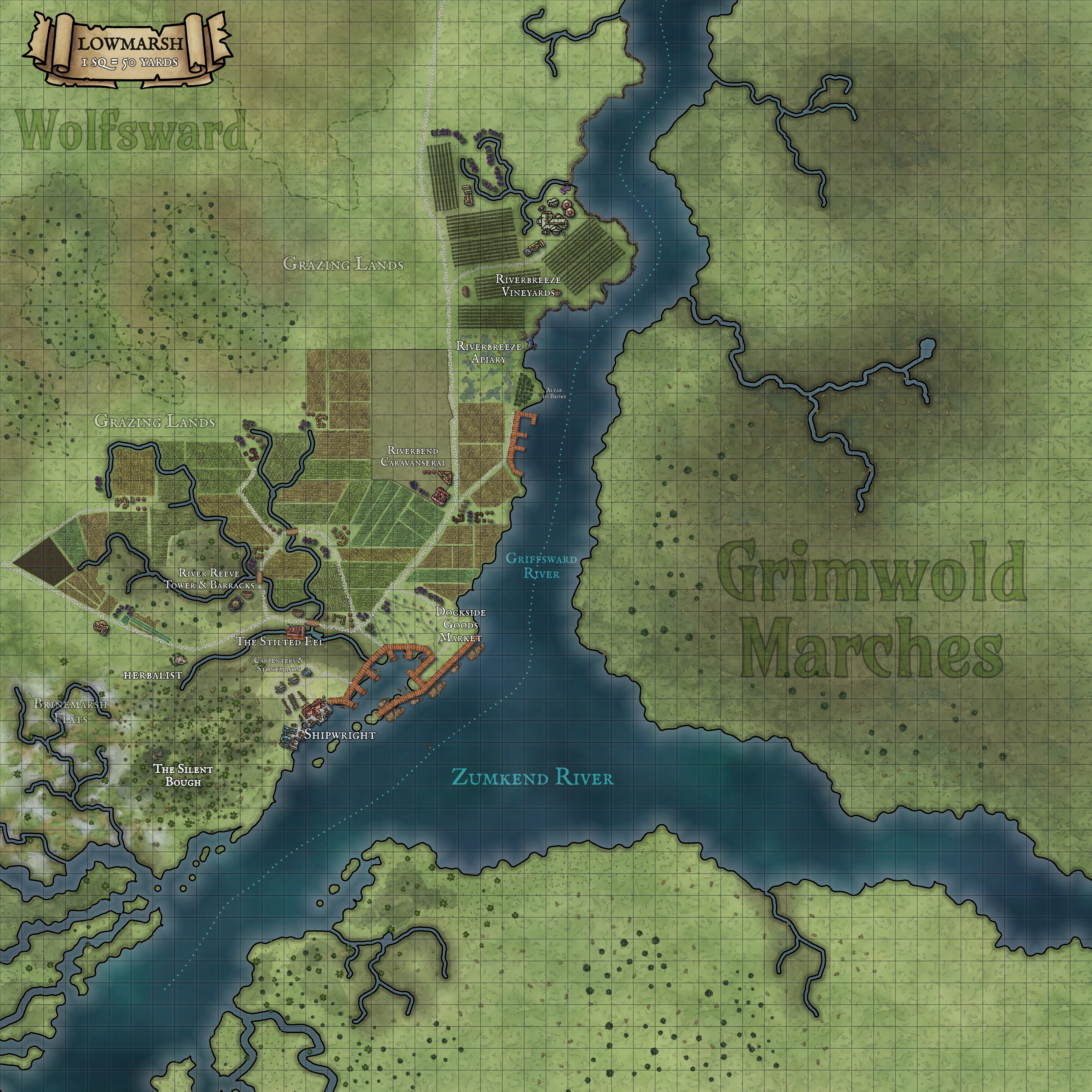
  • Lowmarsh

    Population: ~230

    Demographics: 80% Human (mostly Flan), 15% Half-Elf, 5% Elf (wild)

    Exports: Salt, smoked fish, herbal tonics, pickled goods, beeswax, wine, honey.

    Location: At the confluence of the Zumkend River (E–W) and Griffsward River (N–S), where runoff from Mount Rantaloch and the Griff Mountains feeds the marshy valley.

    Notable Traits: Humid, mossy, perpetually misted. Riverboats moor at tall docks, and the whole town seems on wood pilings even if only a few feet above the ground.

    Places to Go

    The Stilted Eel

    A ramshackle inn-tavern built on stilts over the reed-choked marsh edge. Its main hall smells of fried fish, ale, and river smoke. Lanterns hang from ropes between beams, and the planks sway gently with each heavy step.

    Signature Dish: Smoked pike stew with marsh-onion dumplings. Special Drink: “Eel’s Breath”—a briny spirit distilled with herbs from the marsh, potent enough to make one’s eyes water. Proprietor: Mara Kinlow, a sharp-tongued woman with an ex-ferryman’s sense of humor and a missing left thumb from a boating mishap. Knows everyone’s business.

    Dockside Goods / Market

    There are a dozen or so tent stalls put up through the field near the docks for trade – everything from a bait shop, tackle supplier, and small outfitter for riverfolk to other farmer’s market items. Nets, lanterns, waterproof satchels, and rope are available in the subn-bleached canvas and leather tarps. A faint vinegar smell from nearby pickle barrels from the Falor Pickleworks draws a small following. Honey, wine, and wax is available from members of the Riverbreeze Apiary and Vineyards.

    Owner: Reeve Jannic Falor, a level 2 Ranger (Flan human). Acts as the River Reeve and self-styled “dockwarden.” Deputies: Torn & Pell, level 1 Rangers—often found patrolling the riverbanks or in the marsh lanes. Side Enterprise: The Falor Pickleworks, where his wife Helna Falor produces jars of pickled cucumbers, onions, peppers, and eggs—renowned all across western Tenh. Local Role: Keeps the rivers safe from lizardfolk and smugglers, occasionally hunting beasts with the help of Old Seryl. Rumor: Jannic keeps a ledger of every “unofficial” trade he allows through the river checkpoints.

    Riverbreeze Apiary & Vineyards

    To the northeast lies along the coast several acres of black soil gently sloping towards the raised rocky coast. Large swaths of wildflowers and some more organized floral patches dot 4-5 acre plot filling the air in spring with a perfumed scent. Between the large patches are wicker mounds for bees carefully managed and tended to ensure a crop of honey at the end of summer. Besides honey which is sold up and down the river, beeswax is extracted and processed for a variety of needs – some say they have clients in the capital of Neverond Nevrend but none know who.

    East of the floral forest is a small orchard of figs and apples and on the promontory a shrine giving thanks for the land and the good harvests of field and flower.

    Northern still, the land gently rolls into neat fences of grapes trimmed to almost unnatural precision and causes many a weary walker to stop and admire the labor of the vineyard. Almost 10 acres of grapes keeps several dozen hands busy throughout the year to handle fruit and prepare wine. Barrels and flasks are sold along the river and known for a hundred miles around even begrudgingly admitted to be ‘palatable’ by several grey elves further to the south and west as far as Celene.

    The Silverleaf Remedies

    A neat, dry-aired herbalist’s shop with rows of stoppered jars and bundles of drying reeds. The air hums faintly with astringent scents.

    Proprietor: Bren Talvarn, a 30-something male human herbalist and healer. Educated, pragmatic, and a bit sardonic about “superstitions.” Formerly trained with apothecaries in Calbut before settling here for quiet work. Provides mid-tier herbalism services—can craft up to Tiers III–IV potions and poultices (using the Herbalism Guide system). Specialties: Marsh-onion tonics (resist disease), willowbark poultices (healing), and rare swamp-thistle tinctures (stabilizing effect). Relationship: Employs Old Seryl to fetch rare plants deep in the marsh where leeches and vipers abound. Hook: Keeps a small locked cabinet labeled “Blackroot,” only opened for dire need—or for the right price.

    The Riverbend Caravanserai

    A newer addition (5 years old) along the east bank, built on firmer ground near the ferry junction. Offers travelers stable lodging, cart storage, and open-air stalls. The inn’s interior is simple but well kept.

    Proprietor: Dovan Leth, a gregarious man of 40 with a wide belly and a knack for negotiation. Former river merchant who saw opportunity when trade with Zumkergrod grew. Maintains discreet connections with boatmen and salt traders. Guests: Traders from the Pale, Nyrond, and the Griff foothills frequently stay here. Local Color: A carved post in the center of the courtyard marks flood heights from years past—each notch tells a story.

    The Brinemarsh

    Southwest of the village lie shallow marsh pools where underground brine seeps up and evaporates. Workers scrape the crystals into wooden flats for drying.

    Overseer: Helna Falor manages these with a handful of laborers. Product: “Lowmarsh White,” a clean and flaky salt prized in the Duchy’s markets. Hazard: At high tide, strange phosphorescent eels are seen writhing near the seep holes—believed by locals to be omens of foul weather.

    People to See

    NameRoleDescriptionNotes
    Mara KinlowProprietor of The Stilted EelGruff, practical woman missing a thumb; laughs loudly, drinks harder.Knows all gossip, sometimes hosts smugglers discreetly.
    Reeve Jannic FalorRiver Reeve & Dockside Goods ownerStalwart Flan ranger who keeps the river lanes safe.Has informal authority, trusted by most locals.
    Helna FalorPickle-maker & Salt overseerIndustrious wife of Jannic; beloved for her pickled eggs and practical advice.Stronger-willed than her husband.
    Old SerylWild Elf ranger from PhostwoodTall, silver-eyed, wary. Deeply connected to the marsh spirits.Tolerates humans; respects Bren and Jannic.
    Bren TalvarnHerbalist & HealerEducated human with analytical demeanor, skeptical of superstition.Supplies healing poultices and rare tinctures.
    Dovan LethCaravanserai ProprietorJolly merchant with deep pockets and deeper connections.Sometimes arranges discreet cargo runs.
    Deputies Torn & PellJunior River RangersYoung, loyal, a little reckless.Occasionally act as marsh guides for visitors.

    The Silent Bough (Wild Elf Outriders)

    Among the reeds and willow-grown marshes north of Lowmarsh, a small band of wild elves lives in secrecy, loosely following the leadership of Seryl. The locals think of Seryl as a lone wanderer, but Bren Talvarn (the herbalist) has glimpsed faint signs: tracks that disappear, bowstrings drying over campfires that no human could have reached, and voices like birdsong carried on mist.

    Most villagers dismiss such tales — but Bren and Jannic Falor know better.

    Number: 4–5 elves total, including Seryl. Race/Class: Wild (Wood) Elves — Rangers and Druids (Levels 2–4). Age Range: 100–180 years (youth to early adulthood for elves). Disposition: Wary, proud, and deeply tied to the marsh as their new home. They left the Phostwood over a dispute that cost Seryl’s brother’s life. Disgraced, they were exiled over a misunderstanding and labeled Seryl “the Branchless” meaning he has no family there.

    The trees in the marsh remind them of home and they have taken the surname ‘Envinyamar’ or “those with new homes”. They see humans as careless stewards of a delicate land but see Bren and Jannic as promising and try to encourage the old Flan ways.

    The Envinyamar

    NameRoleDescription
    Seryl ‘the Branchless’Ranger, elder of the bandSilver-haired, pale green eyes, soft-spoken but unyielding. Scarred forearms — old burns from circumstances surrounding his exile from the Phostwood.
    LethienDruidess of the marshQuiet, veiled in woven reeds. Believed to speak with the marsh egrets and the spirits of drowned things. Has traded once with Bren — for salt, not gold.
    FaranelYounger rangerThin, sunburned, fascinated by human tools and the shipwright work to the east. Keeps watch along the river channel.
    TirielScout and archerCynical, distrustful of humans. Uses black-fletched arrows that the Reeve has found embedded in lizardmen carcasses.
    CalithAdolescent, spirit-touchedRarely seen, sometimes glimpsed by children at the edge of the reeds.

    Homestead: A concealed camp amid willow roots on a mound in the center of the marsh woods, camouflaged with living vines.

    Relationship to the Village

    • Bren Talvarn (Herbalist) – The only human who’s knowingly interacted with them. He trades information about herbs and weather for rare marsh ingredients.
    • Reeve Jannic Falor – Aware of Seryl’s companions but keeps their secret, knowing they help keep the riverbanks free of beasts and bandits. Discreetly works with them through Bren.
    • Local View: “Old Seryl’s ghosts.” The villagers believe Seryl’s “kin” are spirits who walk when the fog is thickest. Children dare each other to stay out until they hear the whispering flutes.
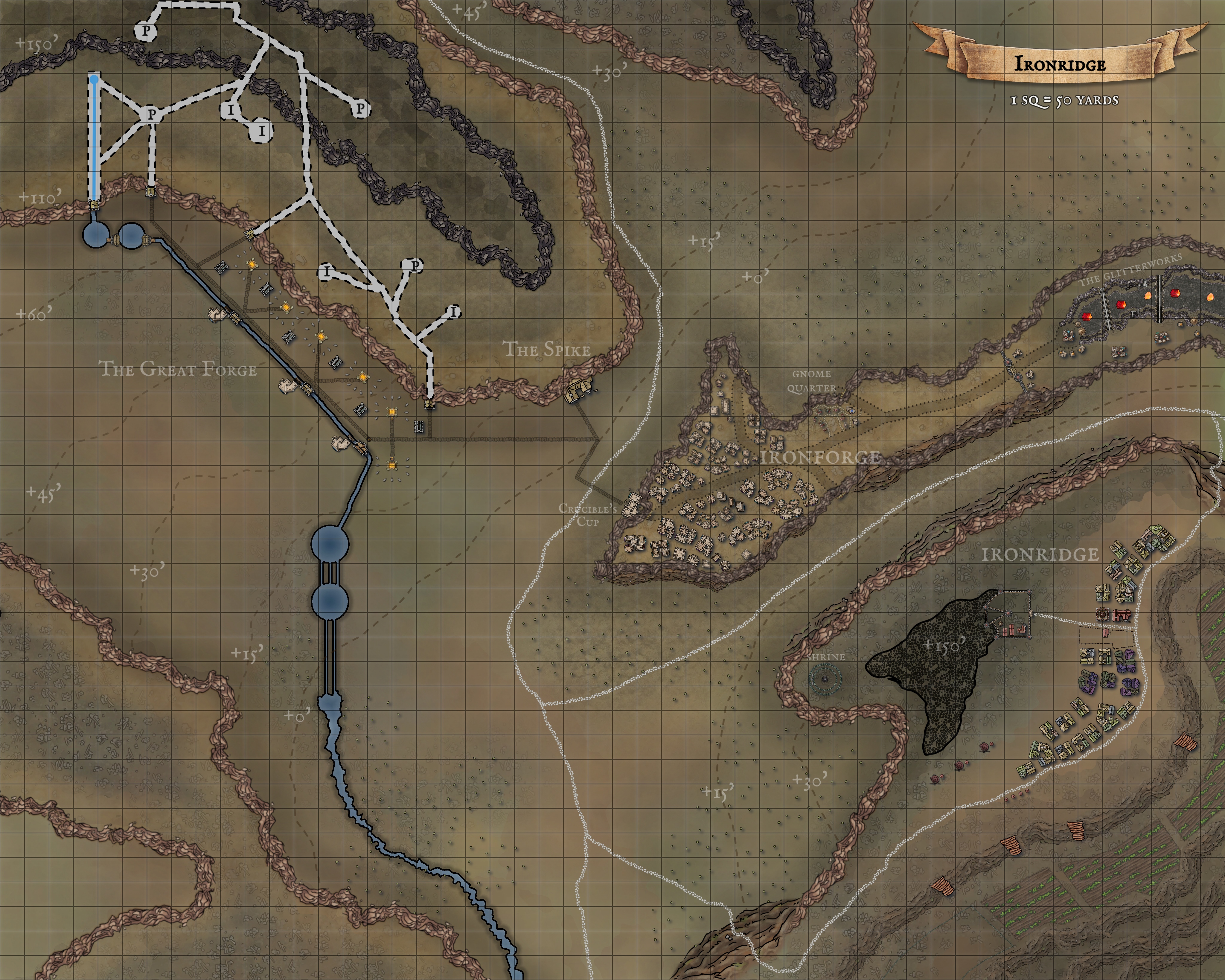
  • Ironridge

    Population: 330 (≈60% Human / 33% Dwarf / 7% Gnome)

    Primary Exports: Iron, platinum, cut stone, smelted ingots, worked metal tools

    Overview

    Ironridge clings to the sloping foothills of the Griff Mountains where veins of iron and platinum lace the dark stone like frozen lightning. Once a modest dwarven charter known as ‘Rautauruuki’, or Ironforge, the site began as a mining claim some 120 years ago and only swelled into a full town during the last two generations as human settlers and gnome engineers arrived.

    The town now straddles two distinct halves:

    Old Town / Ironforge: the original dwarven quarter of low-roofed stone halls and forge-chimneys that never cool.

    New Ironridge: a human-built extension of timber-fronted houses and cobbled lanes laid downslope along the stream.

    A constant haze of wood-smoke and ore-dust marks the skyline, while the steady clang of hammer and pick echoes day and night. Yet beneath the grit lies a proud sense of order and honest craft—Ironridge folk believe that a day’s labor should ring true like well-tempered steel.

    Industry and Trade

    Mining & Quarrying: Two major shafts tap iron and platinum seams, while a nearby open quarry supplies dressed granite for roads and fortifications throughout the Grimwold Marches. Dwarves manage the deeper veins; human crews haul surface ore.

    Engineering & Masonry: About twenty gnomes serve as surveyors, stone-cutters, and gearwrights, maintaining mechanical derricks that hoist massive stone slabs.

    Smelting & Smithing: The Great Forge, fed by a mountain stream redirected through a wheel-driven bellows system, produces high-quality iron and occasional platinum alloy. Tools and weapons from Ironridge bear a discreet hammer-mark shaped like a mountain peak over an ingot—proof of honest work by the charter.

    Places to Go

    The Crucible’s Cup (Tavern)

    A low-roofed taproom dense with pipe-smoke and the smell of stew. The Cup is where miners, masons, and caravanners rub shoulders after dusk. Its thick stews of beef, barley, and onion are ladled from blackened cauldrons kept simmering through each shift. The barkeep, Torga Flintbraid, claims the secret flavor comes from “a century’s worth of soot seasoning.”

    The Iron Spike Inn (“The Spike”)

    A solid stone-and-timber caravanserai serving both teamsters and merchants. Rooms are modest but dry, with wide stables and an attached distillery that produces the infamous Spike Spirits—a potent clear liquor rivaled only by dwarven mead. Proprietor Doran Stonehelm, a beardless (by choice) dwarf, insists on clean ledgers and zero tolerance for smuggling. His annual Iron Stomach Drinking Challenge is part of the celebrated Tenha Tavern Trek chronicled in Grimm’s Guide.

    The Great Forge & Smithy

    Operated by Harl Deepthane and his apprentices, this open-front forge produces most of the region’s ironmongery—from nails and horseshoes to weapons for provincial levies. Buyers from High Haldleigh often commission armor fittings here.

    Assayers’ Guild & Gem Office

    Run by three meticulous gnome gemsmiths—Pivett Nipp, Carloo Glintglimmer, and Jemma Tukkel—the office grades and stamps all precious ore before export. Their work has made Ironridge trusted among traders in Calbut and Zumkergrod alike.

    🌿 Temple of Beory (Shrine to Moradin)

    Atop the town’s central rise stands a stone-walled shrine to Beory the Earth Mother, co-sanctified with a dwarven altar to Moradin. The dual faith reflects the partnership between human and dwarf miners: Beory blesses the living land; Moradin tempers its gifts into form. The matron-priestess, Sister Elenna Marrowfield, is known for blessing pickaxes with “true aim” before new digs.

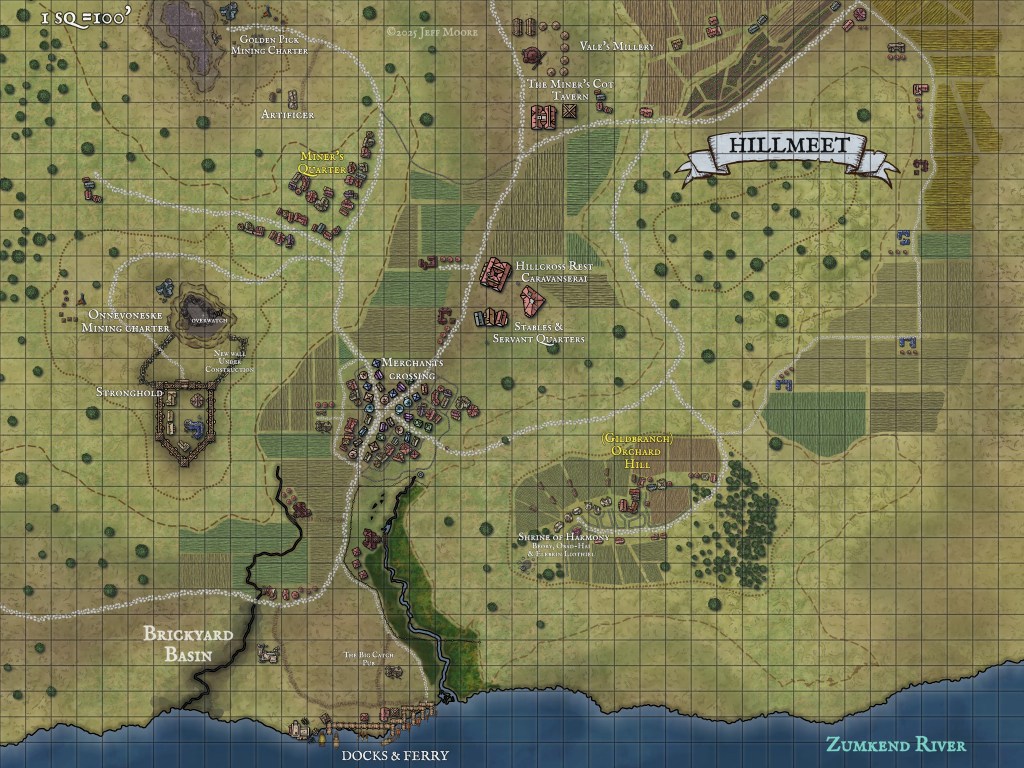
  • Hillmeet

    Once a humble trading stop on the Zumkend River, Hillmeet has grown into a vital waystation between the western frontier and the baronial capital of Rutherton to the east. Merchants from Westwatch bring goods and coin by caravan and ferry alike, feeding Hillmeet’s bustling river trade.

    The Lay of the Land

    Hillmeet rises over two broad hills overlooking the river.
    On the southwestern peak stands Duke’s Point, a rocky bluff said to bear the carved steps of an ancient shrine to Beory and Obad-Hai. Legends whisper of a hidden lookout chamber built beneath the summit — a watch post to guard against trouble along the Zumkend or deep inland.

    The southern hilltop is fortified by a small provincial stronghold, home to two dozen of the Duke’s men-at-arms and their mounts. Ten-foot wooden palisades and watchtowers overlook the town and river. Within lie barracks, a stable, and a great smithy where ore from the local mine is smelted into weapons, tools, and armor.

    Beneath the stronghold, miners delve for iron and rare platinum, always taking care to seek the druids’ blessing before cutting into the earth.

    Trade & Craft

    Hillmeet’s prosperity flows from both road and river. The caravanserai hosts traders and guardsmen on the move — and its discreet master quietly manages “special orders” for certain clients in the Theocracy of the Pale, where unsanctioned magic is frowned upon.

    Whispers persist of an artificer dwelling in the stronghold, fashioning clever devices and enchanted tools for the miners, though most townsfolk dismiss this as another of Hillmeet’s tall tales.

    The Orchard Hill

    To the southeast, Orchard Hill blossoms under the care of the Gildbranch family — half-elven orchardists descended from a pair of druids about 60-70 years prior. While their father passed a few years back, their mother continues to maintain their hill as a place of tranquil beauty: a druidic shrine encircled by wildflowers and herb-gardens, shaded by a grove that borders the meadow shrine of Beory, Obad-Hai, and Elebrin Liothiel, the Seldarine goddess of gardens.

    From the shrine, the Duke’s stronghold is visible across the river valley — a living reminder to look east toward tomorrow, yet never forget the faith that carried the people through hardship.

    Places to Go (Locations & Services)

    The Pick and Lantern (Tavern/Inn)

    • Loud, smoky, and crowded with miners, prospectors, and scouts.
    • Proprietor: Kaelen Varric (half-elf, sharp-eyed, rumored to fence smuggler goods).
    • Famous for its “Lantern Ale” (strong brew served in heavy copper mugs).
    • Frequent brawls; mercenaries and adventurers are welcome, but fights are expected.

    The Miners’ Cot (Lodging House)

    • Long timber hall with rough plank bunkrooms.
    • Keeper: Old Gerrin Vale (human, retired miner, stiff leg).
    • 1 sp per night; hammocks strung above bunks for overflow.

    Smithy (within the Stronghold)

    • Run by Sera Broddan, dwarf woman, specialist in tools, lamp fittings, and pickaxes.
    • Known to produce “blasting wedges” — reinforced chisels for quarry and ore work.

    Alchemist’s

    • A small wide house made of stone block with a slab roof at the northwest hill with two small vertical windmills slowly twirling in the wind. Nella’s ‘home’ which looks very much like a propspector’s hut has various tools leaning in groups near the front.
    • Proprietor: Nella Quen is gnome alchemist (and artificer), sells potions (healing, climbing, water breathing), lamp oil, blasting powder (strictly “for mining”).
    • Also dabbles in fireworks; colorful test rockets often explode over the river.

    Brickworks & Peat Yard

    • Mud-brick drying fields and clay pits along the riverbank.
    • Fuel from a bog east/south of the town, harvested by teams of brickmakers.
    • Provides essential bricks for Hodnet, Rutherton, and outlying keeps.

    Merchants Crossing

    • Market stalls line the approach, selling grain, smoked fish, pottery, and ore samples.
    • Monthly fair draws miners, herders, and a handful of dwarves from Grimwold March.

    People to See (NPCs)

    • Kaelen Varric (Innkeeper, Pick and Lantern): Half-elf, opportunistic, deals in rumors and sometimes stolen goods.
      • Not related to the Gildbranch family at all; views them with a touch of antipathy as ‘being so earth-minded they’re no earthly good’. Originally from the Gamboge Forest.
      • Affiliated with the Rustjaw Circle Thieves Guild, occasionally fences goods to Darsen at the Hillcross Rest.
      • Medium half-elf, neutral (leans chaotic neutral)
      • Rogue (Mastermind archetype), Level 3
      • AC 12 HP 24 (3d8 + 9) Speed 30 ft
      • STR 10 DEX 14 CON 14 INT 12 WIS 11 CHA 15
      • Skills Deception +4, Insight +2, Persuasion +4, Sleight of Hand +4, Stealth +4
      • Languages Common, Elvish, Thieves’ Cant
      • Sneak Attack (1d6) once/turn with finesse/ranged weapon.
      • Cunning Action: Dash, Disengage, or Hide as a bonus action.
      • Master of Rumor: Advantage on checks to gather or conceal information in town.
      • Equipment: Dagger, concealed blackjack, ledger of coded debts, silver amulet shaped like a lantern.
      • Personality & Roleplay
        • Speaks smoothly, always appraising customers for profit or potential trouble.
        • Pretends neutrality but secretly trades in smuggled goods from the Pale.
        • Has a soft spot for underdogs and desperate adventurers (“Everyone needs a start, eh?”).
    • Darsen Veyne, “the Honest Broker” – proprietor of the Hillcross Rest caravanserai
      • Medium human (Oeridian/Flan mix), neutral good (with pragmatic leanings)
      • Expert (Trader / Negotiator)
      • AC 12 (sturdy coat) HP 27 (5d8 + 5) Speed 30 ft
      • STR 10 DEX 12 CON 12 INT 13 WIS 14 CHA 15
      • Saving Throws Wis +4, Cha +4
      • Skills
        • Insight +4, Persuasion +6, Deception +4, History +3, Investigation +3
        • Languages Common, Flan, a smattering of Pale Cant
      • Equipment Ledger book, signet of Duke’s tax charter, hidden coin scales, short sword (rarely used).
      • Abilities (Narrative-Level)
        • Seasoned Trader. Advantage on checks to appraise goods or detect smuggling.
        • Silver Tongue. Once per long rest, can charm or calm a hostile NPC with a DC 13 Persuasion contest (“Let’s not ruin a profitable morning, friend.”).
        • Grey Market Contact. Knows the courier routes to the Theocracy of the Pale and discreet smugglers heading west via Perrin Holt’s network.
      • Optional Combat Notes (if needed):
        • +3 to hit with shortsword (1d6+1), +4 with light crossbow (1d8+1). Not a frontline fighter; will flee or bargain rather than draw blood.
    • Old Gerrin Vale (Lodging Keeper): Retired miner, bitter about the Duke’s levies, sympathetic to Flan traditions.
    • Sera Broddan (Dwarven Smith): Stocky, practical, loyal to the miners, not entirely sure about the alchemist though…
      • Medium dwarf (hill dwarf), lawful neutral
      • Expert (Blacksmith / Fighter background), Level 4
      • AC 15 (chain shirt, smith’s gauntlets) HP 38 (4d8 + 16) Speed 25 ft
      • STR 16 DEX 10 CON 16 INT 11 WIS 12 CHA 10
      • Skills Athletics +5, History +3, Smith’s Tools +6, Perception +3
      • Dwarven Resilience: Advantage vs. poison, resistance to poison damage.
      • Second Wind (1/rest): Regain 1d10 + 4 HP.
      • Forge Temper: Can create or repair nonmagical metal gear twice as fast; weapon or armor she crafts gains +1 to damage or AC for 7 days (masterwork effect).
      • Equipment: Blacksmith’s hammer (counts as light hammer), chain shirt, iron tongs, flask of forge-oil.
      • Personality & Roleplay
        • Gruff, practical, blunt. She has little patience for “dreamers or drunkards.”
        • Deep loyalty to miners; considers them “my lads and lasses of the flame.”
        • Keeps a hidden iron token of Moradin under her apron, though outwardly reveres Beory out of respect.
    • Nella Quen (Gnome Alchemist): Eccentric, half-mad, fiercely protective of her “research.”
      • Small gnome (rock gnome), chaotic good (eccentric inventor)
      • Artificer (Alchemist), Level 4
      • AC 13 (leather apron + dex) HP 27 (4d8 + 8) Speed 25 ft
      • STR 8 DEX 14 CON 14 INT 16 WIS 10 CHA 12
      • Skills
        • Arcana +5, Investigation +5, Nature +5, Sleight of Hand +4
        • Languages Common, Gnomish, Dwarvish
        • Alchemical Savant: Adds +3 to one roll of healing/restorative potion she brews.
        • Experimental Elixirs (2/day): Randomly produces potions (roll or choose): Healing, Swiftness, Resilience, Boldness, Flight, Transformation.
        • Tinker (3 tiny devices): Mini rocket, smoke beetle, or spark lighter.
      • Equipment: Satchel of vials, tools, goggles, two “test rockets,” and a small crossbow.
      • Personality & Roleplay
        • Talks quickly and forgets half her thoughts mid-sentence; finishes them hours later.
        • Keeps a wary distance from officials after an “unfortunate fireworks accident.”
        • Deeply protective of her inventions and secretly hopes to discover perpetual fire.
      • Optional Hooks
        • Offers friendly PCs unique potions or fireworks at reduced cost in exchange for rare reagents from the bog or mine.
        • May be hunted by The Pale’s inquisitors for “unsanctioned magic.”
    • Captain Harlowe Dane (Reeve-Captain): Stern Flan soldier posted with 25-30 men.
      • Fighter 4 (Champion archetype reflavored as Reeve)
      • AC 17 (chain mail, shield) HP 45 (4d10 + 16) Speed 30 ft
      • STR 16 DEX 12 CON 16 INT 11 WIS 13 CHA 14
      • Saving Throws Str +5, Con +5 Skills Athletics +5, Insight +3, Intimidation +4, Perception +3, Persuasion +4
      • Senses passive Perception 13 Languages Common, Flan
      • Combat Actions
        • Multiattack. Two melee attacks per round.
        • Longsword. +5 to hit, 5 ft reach, 8 (1d8 + 4) slashing or 9 (1d10 + 4) two-handed.
        • Heavy Crossbow. +3 to hit, range 100/400 ft, 6 (1d10 + 1) piercing.
        • Second Wind (1/rest). Regain 1d10 + 4 HP as a bonus action.
        • Action Surge (1/rest). Take one additional action on your turn.
        • Reeve’s Authority (reflavored Rallying Cry). When he uses Second Wind, up to 3 allies within 30 ft who can see or hear him regain 1d8 HP and have advantage on their next Wisdom (Insight or Perception) check — representing disciplined coordination and morale.
        • Improved Critical. Scores a critical hit on 19–20.

    Demographics

    • ~200-250 total: ~170 humans (mostly Flan), 25 dwarves, 20 halflings, 10 gnomes, 6 half-elves.
    • Humans dominate civic leadership, dwarves run most mining operations, halflings/gnomes more common in Lower Hillmeet artisan trades. Half-elves have an orchard on the southeast hill.

    Dungeons & Dragons and Greyhawk are © Wizards of the Coast. All original material © 2025 Jeff Moore (Greywolf Comics / greywolfcomics.org). Used for noncommercial fan content.

  • SGWC 2.0

    Kiken na jōsen (“Dangerous Affair”)

    Historical Background

    Developed at Starfleet Academy as a precursor to the infamous Kobayashi Maru, the Kiken na Jōsen (“Dangerous Affair”) scenario tested a cadet’s ability to manage rescue operations under hostile conditions. Known among trainees by the less formal nickname “Kick in Your Johnson” or simply KNJ, the exercise forced command candidates to weigh risk against duty—placing their crews in danger to save others.

    In later years, the simulation was updated for active-duty officers as a command refresher, adapted to include encounters with Andromedan forces using only the fragmentary intelligence then available. It remains a cornerstone of Starfleet’s crisis command curriculum, emphasizing judgment, discipline, and the limits of control under pressure.

    Scenario Start

    Freighter Convoy Group Jisho has sent a distress call while traversing the borderlands between Federation, Tholian, and Romulan space.

    Their engines have failed inside volatile subspace distortion pockets.

    The Federation’s rescue flotilla races to extract the freighters before a rival force arrives to seize them.

    Neither side may destroy the convoy—doing so risks political disaster and mission failure.

    This exercise trains crews in tractor coordination, towing under duress, and disciplined engagement amid subspace anomalies.

    Scenario Parameters

    Category Details

    Players 2–6 (1–3 ships per side)

    Map Fixed

    Duration 8 turns or until all convoy ships are rescued or captured

    Hazard: Subspace Distortion Zones

    The Convoy (Neutral Objective)

    Convoy Group Jisho consists of 2–6 stranded transports, equal to the total of Side A and Bs ships, each trapped within the subspace distortion zone.

    • SS Assurance
    • SS Buckaroo Banzai
    • SS Cyberdyne Express
    • SS Deneva Freight
    • SS E
    • SS F

    • May power shields, tractors, but not weapons (fire control is disrupted within the distortion zone).

    • Freighters once outside the subspace distortion require one full turn of being clear before they can use power for movement. If a freighter is pulled clear on Turn 3, impulse 16, it can use power for movement starting turn 5. Freighters cannot voluntarily disengage by high speed but must move/be towed off the map.

    • Neither side may target convoy ships intentionally.

    • If any convoy unit is destroyed, both sides lose 10 VP per ship.

    Recommended Mix

    Scale # Ships Composition Notes

    1 F-OL per ship in Side A and B

    has 2x Medical Skids

    No Ducktail skid 

    Setup

    1. Place each freighter in a separate subspace distortion zone (see map) starting with Zone Alpha, then Bravo, then Charlie. Repeat starting at Alpha with the fourth to sixth freighter. Freighters are all two hexes inside of the subspace zones.

    2. Side A (Rescue Force) enters hex column 01xx within 4 hexes of 0103, speed 16, WS-III.

    3. Side B (Ambush Force) enters from the opposite edge (baseline Speed 24); if Cloaking Devices are available see special option.

    Subspace Distortion Zones

    • Entering units immediately halt and cannot generate warp movement.

    • Tractor towing costs × 3 while inside.

    • Seeking weapons, shuttles, fighters entering a zone are destroyed. Transporters cannot be used across subspace distortion zones (including into or out of). Transporter mines could be rolled out of the hatch.

    • Fire Control is disabled for ships within the zones; they are disabled as long as they remain inside. Fire control is reestablished the impulse they exit.

    • Convoy ships begin inside zones.

    ⚔️ Forces

    Side A – Rescue Force

    Objective: Tow convoy ships off your entry edge.

    Fleet Size: 1–3 ships (≈ 350–500 BPV).

    Empire Example Rescue Group BPV

    Federation CA + CL + FF ~410

    Klingon D7 + D6 + F5 ~400

    Hydran RN + DG + KN ~390

    Lyran CA + CW + DW ~390

    Gorn BC + CM + DD ~400

    Kzinti BC + CM + FF ~380

    Tholian CA + DD + PC ~370

    Orion (Merc.) CR + HR + LR ~420

    Side B – Ambush Force

    Objective: Capture convoy ships by towing them off your own entry edge or if the freighters are captured moving off the map .

    Restrictions: May not deliberately damage convoy ships.

    Fleet Size: 1–3 ships (≈ 400–500 BPV).

    Empire Example Ambush Group BPV

    Romulan KR + 2 × WE ~390

    Tholian CA + DD + PC ~370

    Klingon D7 + F5 + E4 ~370

    Lyran CW + DW + FF ~380

    Orion Raiders HR + 2 × LR ~390

    Andromedan (Training) Intruder + 2 × Cobra  (or Conquistador + Mamba + Cobra) ~400

    Andromedan Special Rules

    • Displacement Devices cannot be used due to subspace distortion

    • PA panels and satellite operations function normally.

    • Andros may appear only as Ambush Force.

    • Designed to train power management and satellite tactics without DisDev complexity.

    🕵️ Optional Rule – Hidden Cloak Deployment

    (Recommended for Romulan or Orion Ambush forces.)

    1. Initial Hidden Placement:

    • Cloaked ships begin the scenario unplotted on the map within 12 hexes of a subspace zone AND no further than hex column 28xx.

    • The owning player secretly records each unit’s starting hex and facing.

    2. Hidden Movement:

    • Each impulse, the cloaked player records movement and speed privately (may use a log sheet).

    • Normal movement limits and terrain apply.

    • They may not enter Subspace Zones while hidden.

    3. Decloaking:

    • When a unit decloaks, immediately place its counter on the board at the recorded location.

    • It may act normally thereafter.

    4. Post-Reveal:

    • Once revealed, future cloaks use standard rules (double range + 5 method).

    • Hidden redeployment is not permitted again this scenario.

    This rule adds fog-of-war tension and simulates the sudden strike of a Romulan bird-of-prey or Orion corsair emerging from distortion shadow.

    🎯 Victory Conditions

    Objective VP

    Convoy ship towed off your edge (Rescued or Captured) +10 each

    Enemy ship crippled +2

    Enemy ship destroyed +5

    Any convoy ship destroyed (any cause) –10 to both sides

    Victory Levels

    • Major Victory:  25 + VP margin

    • Minor Victory:  10–24 VP margin

    • Draw:  < 10 VP difference

    🧩 Optional Variants

    • Heavy Tow: Replace one freighter with Ore Carrier (F-OL, 1¼ move cost).

    • Mixed Convoy: Add damaged Federation Express for light-hull towing.

    • Fog of War: Ambush force may begin hidden within 6 hexes of entry edge (even without cloak).

    🎓 Training Focus

    • Tractor and towing operations under pressure.

    • Escort coordination and counter-tractor tactics.

    • Power allocation discipline in subspace hazards.

    • Andromedan energy and satellite management without Displacement Devices.

    • Introduction to hidden movement and cloaking surprise tactics.

  • D20 WAR-MODE SYSTEM

    A role system for resolving battles and wars in fantasy settings, with optional PC integration.

    INTRODUCTION

    The d20 War-Mode System is a simplified combat framework designed to resolve large-scale battles and wars while preserving the tone and tactics of D&D 5e.

    It abstracts creatures, heroes, and armies into streamlined ratings—Offense, Defense, Magic, and Steps—allowing quick yet faithful outcomes.

    Unlike traditional wargames, War-Mode keeps the fantasy motif alive: giants hurl boulders, wizards rain fire, clerics hold the line, and player characters can meaningfully sway the tide of battle without rolling hundreds of dice.

    CORE CONCEPTS

    Each unit—whether a squad of soldiers, a band of orcs, a giant, or a dragon—has six attributes rated from 0 to 20 (similar to ability modifiers on a d20 scale).

    These numbers replace attack rolls, AC, saving throws, and DCs.

    Meaning

    Typical Range

    Melee Offense (MO)

    Attack power in close combat

    4–20

    Ranged Offense (RO)

    Accuracy and impact at range

    2–18

    Physical Defense (PD)

    Armor, agility, toughness

    4–20

    Magical Offense (MgO)

    Spellcasting, breath weapons, divine smite

    0–20

    Magical Defense (MgD)

    Magical resilience, saving throws

    4–20

    Steps (Durability)

    Structural integrity, morale, or HP abstraction

    3–10

    Movement

    Each unit’s movement rate is measured in 50-yard increments per battle turn (30 seconds). • 30 ft speed = 1 Move • 40 ft = 1.5 Move • 50 ft = 2 Move • Mounted +1.5 Move • Tags like Fly X, Climb +1, Swim +1 modify movement by terrain type.

    ROLLING COMBAT

    All combat uses one roll per attack. The Margin of Success (MOS) determines damage.

    1. Choose attack type (Melee, Ranged, or Magical).

    2. Roll: d20 + Offense vs 10 + Defense.

    3. Subtract to find MOS.

    4. Convert MOS to Steps lost:

    Margin of Success

    Steps Lost

    Result

    < 0

    0

    Miss

    0–4

    1

    Light hit / casualties

    5–9

    2

    Solid strike / heavy casualties

    10+

    3

    Devastating blow / rout risk

    When a unit loses all its Steps, it is destroyed or scattered.

    Losing 2+ Steps in a turn can also trigger a Morale check.

    MORALE

    Units check Morale whenever they:

    Lose 2 or more Steps in one turn, or Their side falls below 50% total Steps remaining.

    Roll: d20 + Quality vs 12 + Steps lost this turn

    Unit Quality

    Bonus

    Militia

    +2

    Trained

    +4

    Veteran

    +6

    Elite

    +8

    Monstrous / Legendary

    +10

    Fail → Fall Back (disengage, regroup)

    Fail by 5+ → Rout (flee or are removed from battle)

    COVER & FORTIFICATIONS

    Cover affects both PD and MgD equally when applicable.

    Cover Type

    Defense Bonus

    Notes

    Light (25%)

    +2

    Bushes, fences, wagons

    Moderate (50%)

    +4

    Barricades, palisades

    Heavy (75%)

    +6

    Stone walls, parapets

    Full

    Impassable

    Wall of Force, cliff face

    Stockade or Stakes: +4 PD front arc; Large/charging attackers −2 Offense. Earthwork / Parapet: +6 PD; ranged attacks limited to 1 Step max. Stone Wall or Keep Gate: PD 18, Steps 6; breached when reduced to 0.

    SPECIAL TAGS

    These traits modify specific rolls or situations.

    Tag

    Effect

    Leader / Standard

    +2 Offense (melee or ranged) to allies within ~50 yards.

    Pack Tactics

    +1 Offense when two or more allied units engage the same target.

    Shield Wall

    +1 PD when adjacent to allied unit in formation.

    Brace vs Large+

    +2 Offense when holding against a charge from a Large+ enemy.

    Flank / Rear

    +2 Offense when attacking a target engaged on multiple sides.

    Evasion

    +2 effective MgD vs AoE; MOS 0–4 causes 0 Steps.

    Medic / Cleric

    Prevent 1 Step of losses per turn across nearby units; +2 Quality on Morale.

    Flight / Climb / Swim

    Grants movement type and bypasses certain obstacles.

    RESISTANCES, IMMUNITIES, AND VULNERABILITIES

    This system handles energy types and damage immunities simply and consistently.

    Condition

    Adjustment

    Example

    Resistant (Type)

    +4 Defense vs that damage type

    Fire Elemental vs Fireball

    Immune (Type)

    No effect from that damage type

    Frost Giant vs Cone of Cold

    Vulnerable (Type)

    −4 Defense or +1 Step when hit

    Troll vs Fire

    SPELLS AND EFFECTS

    Treat spells as templates with one of the following effects:

    Blasts & Breaths:

    Use MgO vs MgD for each target in the area. Apply resistances/immunities as above.

    Walls:

    Wall of Force — impassable; blocks line of effect; grants +4 PD/MgD behind it. Wall of Fire — creates a hazard template; crossing or starting in it inflicts one MgO roll per turn.

    Control (Fog, Darkness, Fear):

    Fog/Darkness → ranged attacks −4 Offense if firing through/into. Fear → immediate Morale check. Slow → target −2 Offense, half movement.

    Buffs:

    Bless, Haste, Heroism → +1–2 Offense or +2 Quality (morale) to up to three units.

    Debuffs:

    Bane, Bestow Curse → −2 Offense or −2 Quality to 1–2 units.

    Healing / Medics:

    Each cleric prevents 1 Step of losses per turn across adjacent allies.

    Concentration:

    If the caster loses 2+ Steps in a turn, make a check:

    d20 + level bonus vs 12 + Steps lost. Fail = spell ends.

    DERIVING VALUES FROM THE MONSTER MANUAL

    You can create war-mode stats for any creature in 60 seconds.

    Step 1: Determine CR → √CR = r

    Step 2: Use these formulas:

    MO = clamp(4 + 4r, 2, 20) PD = clamp(4 + 3.5r, 2, 20) MgO = 0 if CR < 3, else clamp(4 + 3.8r, 2, 20) MgD = clamp(4 + 3.5r, 2, 20) Steps = max(3, 2 + round(r)) RO = MO − 2 (if real ranged) or MO/2 (if harassing)

    Step 3: Adjust ±1–3 for:

    High attack bonus (+11 or higher) → +1 Offense High AC (18–20) → +1–2 PD Magic Resistance / Legendary Resistance → +2 MgD AoE breath or Fireball-tier spell → ensure MgO ≥ 12 Vulnerabilities or poor defense → −1–2 PD/MgD

    Step 4: Add Tags (flight, reach, pack tactics, etc.)

    DERIVING VALUES FROM PLAYER LEVEL OR HIT DICE

    Use this table to convert NPCs, classed characters, or troops by level or HD.

    Level or HD

    Melee Offense

    Physical Defense

    Magical Offense

    Magical Defense

    Steps

    Notes

    1

    6

    6

    0

    6

    3

    Basic militia

    2

    7

    6

    2

    7

    3

    Trained unit

    3

    8

    7

    3

    8

    3

    Veteran squad

    4–5

    9–10

    8–9

    4–5

    8–9

    3–4

    Capable soldiers

    6–8

    11–13

    9–10

    6–8

    10–11

    4

    Elite

    9–12

    14–16

    12–13

    10–15

    12–14

    4–5

    Heroes / commanders

    13–16

    17–18

    14–16

    15–18

    14–16

    5

    High heroes

    17–20

    19–20

    17–18

    18–20

    17–18

    5

    Legends / paragons

    Use Hit Dice instead of level for monsters or NPCs without CR:

    Treat each 2 HD ≈ 1 level for this conversion. A 6 HD creature ≈ level 3; a 12 HD creature ≈ level 6.

    UNIVERSAL BENCHMARKS

    Use these for sanity checking.

    Category

    Example

    MO

    PD

    MgO

    MgD

    Steps

    Goblin (CR 1/4)

    Weak skirmisher

    3

    3

    0

    3

    3

    Orc (CR 1)

    Basic troop

    6

    4

    0

    3

    3

    Veteran Pikeman (level 3)

    Human elite

    8

    7

    0

    8

    3

    Ogre (CR 2)

    Heavy brute

    10

    8

    0

    4

    3

    Hill Giant (CR 5)

    Massive shock unit

    16

    14

    0

    6

    6

    Cloud Giant (CR 9)

    Elite brute

    18

    16

    8

    12

    7

    Storm Giant (CR 13)

    Legendary elite

    20

    18

    14

    14

    8

    Adult Dragon (CR 15)

    Apex threat

    20

    18

    18

    16

    9

    Titan (CR 22)

    Demi-god

    20

    20

    18

    18

    9

    BUILDING BATTLES

    Use these quick force ratios:

    Infantry vs Hill Giants: 40–50 disciplined infantry per giant (pikes + leader). Add 1 mage per 40–50 and 1 cleric per 30–40 for sustainability. Cavalry vs Fire Giants: 6–7 heavy cavalry per giant with charge, leader, and flank bonuses. Dragon Assault: 2 heavy ballistae + 1 mid-tier wizard + 100 veteran troops can repel a single adult dragon. Defensive Fort: Infantry behind 50–75% cover can survive 2–3 times longer against ranged or magical assault.

    DESIGNER DIALS

    To fit your table’s tone:

    Monsters tougher? +1–2 Steps. Shorter battles? Auto-rout at 60% Steps lost. Bloodier? Add a “MOS 15+ → 4 Steps” tier. Low-magic campaign? −2 MgO globally. High-fantasy war? Allow heroes to reroll failed Morale once per battle.

    WORKED EXAMPLE: FIREBALL VS OGRES

    Wizard (Level 9): MgO 15

    Ogre: MgD 4, Steps 3

    Roll: d20 + 15 vs 14

    Average result (10.5 + 15 = 25.5) → MOS ≈ 11.5 → 3 Steps each.

    Each ogre in the blast is destroyed outright.

    If resistant (e.g., Fire Resistance), +4 MgD → 18; MOS ≈ 7.5 → 2 Steps (wounded, not destroyed).

    WORKED EXAMPLE: CLOUD GIANT VS FORTIFIED PIKES

    Cloud Giant (MO 18) vs Veteran Pikes (PD 10 +6 for parapet = 16)

    Roll: d20 + 18 vs 26 → need 8+. Average MOS ~2 → 1 Step (glancing).

    Pikes with Brace (+2) strike back: MO 10 vs PD 16 → MOS ~0–4 → 1 Step on a hit.

    The wall holds for multiple turns; siege equipment or spells are needed.

    SUMMARY CHECKLIST

    Roll once per attack: d20 + Offense vs 10 + Defense. Margin of Success → Steps (0/1/2/3). Morale at 2+ Steps lost or 50% casualties. Apply terrain: +2/+4/+6 for 25/50/75% cover. Resistances: +4 Defense; Immunity: no effect; Vulnerability: −4 or +1 Step. PCs use simplified war stats by level. You can derive any monster instantly from CR or HD. Keep it cinematic—each roll represents a wave of violence, not a single strike.