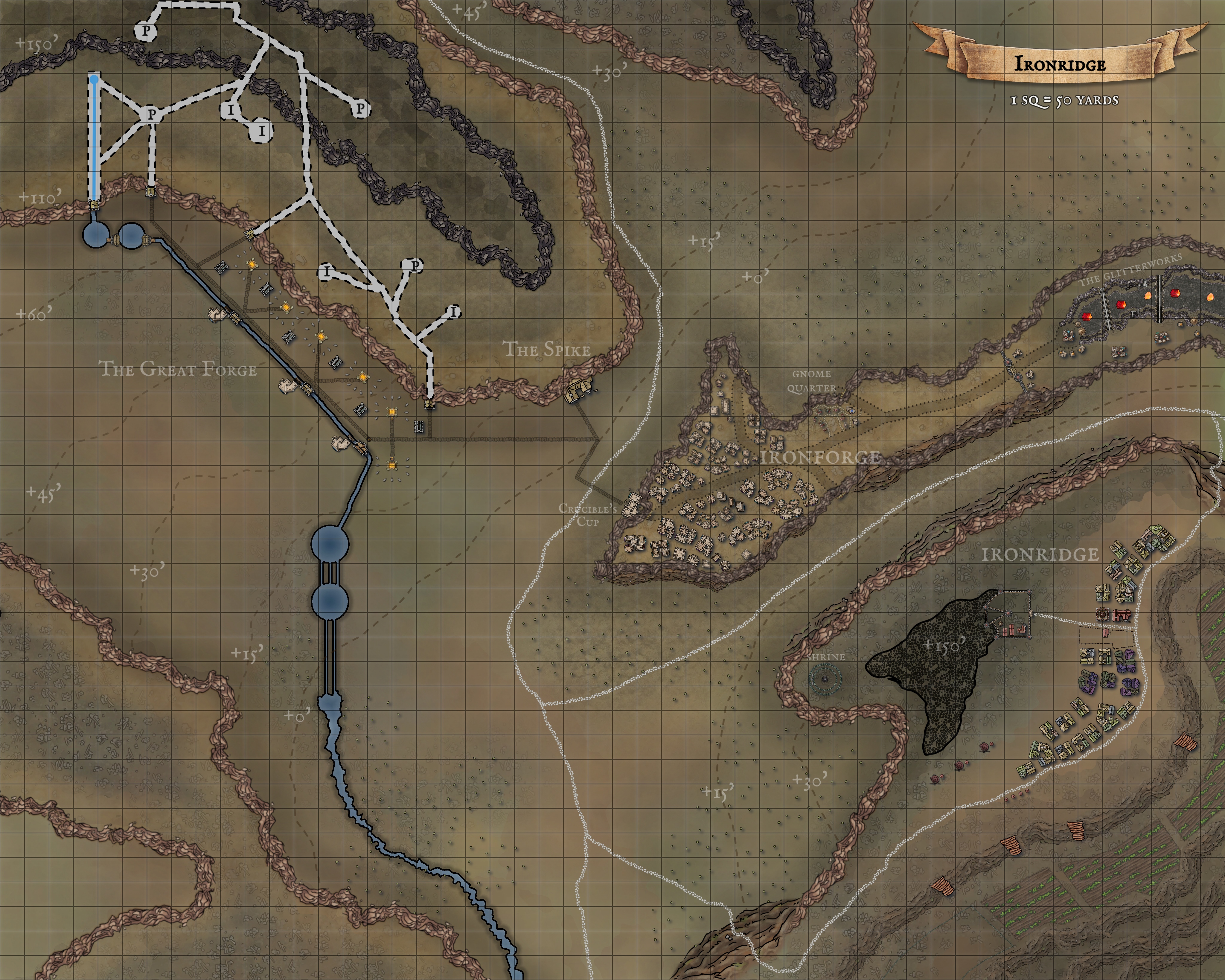
Population: 330 (≈60% Human / 33% Dwarf / 7% Gnome)
Primary Exports: Iron, platinum, cut stone, smelted ingots, worked metal tools
Overview
Ironridge clings to the sloping foothills of the Griff Mountains where veins of iron and platinum lace the dark stone like frozen lightning. Once a modest dwarven charter known as ‘Rautauruuki’, or Ironforge, the site began as a mining claim some 120 years ago and only swelled into a full town during the last two generations as human settlers and gnome engineers arrived.
The town now straddles two distinct halves:
Old Town / Ironforge: the original dwarven quarter of low-roofed stone halls and forge-chimneys that never cool.
New Ironridge: a human-built extension of timber-fronted houses and cobbled lanes laid downslope along the stream.
A constant haze of wood-smoke and ore-dust marks the skyline, while the steady clang of hammer and pick echoes day and night. Yet beneath the grit lies a proud sense of order and honest craft—Ironridge folk believe that a day’s labor should ring true like well-tempered steel.
Industry and Trade
Mining & Quarrying: Two major shafts tap iron and platinum seams, while a nearby open quarry supplies dressed granite for roads and fortifications throughout the Grimwold Marches. Dwarves manage the deeper veins; human crews haul surface ore.
Engineering & Masonry: About twenty gnomes serve as surveyors, stone-cutters, and gearwrights, maintaining mechanical derricks that hoist massive stone slabs.
Smelting & Smithing: The Great Forge, fed by a mountain stream redirected through a wheel-driven bellows system, produces high-quality iron and occasional platinum alloy. Tools and weapons from Ironridge bear a discreet hammer-mark shaped like a mountain peak over an ingot—proof of honest work by the charter.
Places to Go
The Crucible’s Cup (Tavern)
A low-roofed taproom dense with pipe-smoke and the smell of stew. The Cup is where miners, masons, and caravanners rub shoulders after dusk. Its thick stews of beef, barley, and onion are ladled from blackened cauldrons kept simmering through each shift. The barkeep, Torga Flintbraid, claims the secret flavor comes from “a century’s worth of soot seasoning.”
The Iron Spike Inn (“The Spike”)
A solid stone-and-timber caravanserai serving both teamsters and merchants. Rooms are modest but dry, with wide stables and an attached distillery that produces the infamous Spike Spirits—a potent clear liquor rivaled only by dwarven mead. Proprietor Doran Stonehelm, a beardless (by choice) dwarf, insists on clean ledgers and zero tolerance for smuggling. His annual Iron Stomach Drinking Challenge is part of the celebrated Tenha Tavern Trek chronicled in Grimm’s Guide.
The Great Forge & Smithy
Operated by Harl Deepthane and his apprentices, this open-front forge produces most of the region’s ironmongery—from nails and horseshoes to weapons for provincial levies. Buyers from High Haldleigh often commission armor fittings here.
Assayers’ Guild & Gem Office
Run by three meticulous gnome gemsmiths—Pivett Nipp, Carloo Glintglimmer, and Jemma Tukkel—the office grades and stamps all precious ore before export. Their work has made Ironridge trusted among traders in Calbut and Zumkergrod alike.
🌿 Temple of Beory (Shrine to Moradin)
Atop the town’s central rise stands a stone-walled shrine to Beory the Earth Mother, co-sanctified with a dwarven altar to Moradin. The dual faith reflects the partnership between human and dwarf miners: Beory blesses the living land; Moradin tempers its gifts into form. The matron-priestess, Sister Elenna Marrowfield, is known for blessing pickaxes with “true aim” before new digs.
 Greywolf Comics & Media
Leave a comment