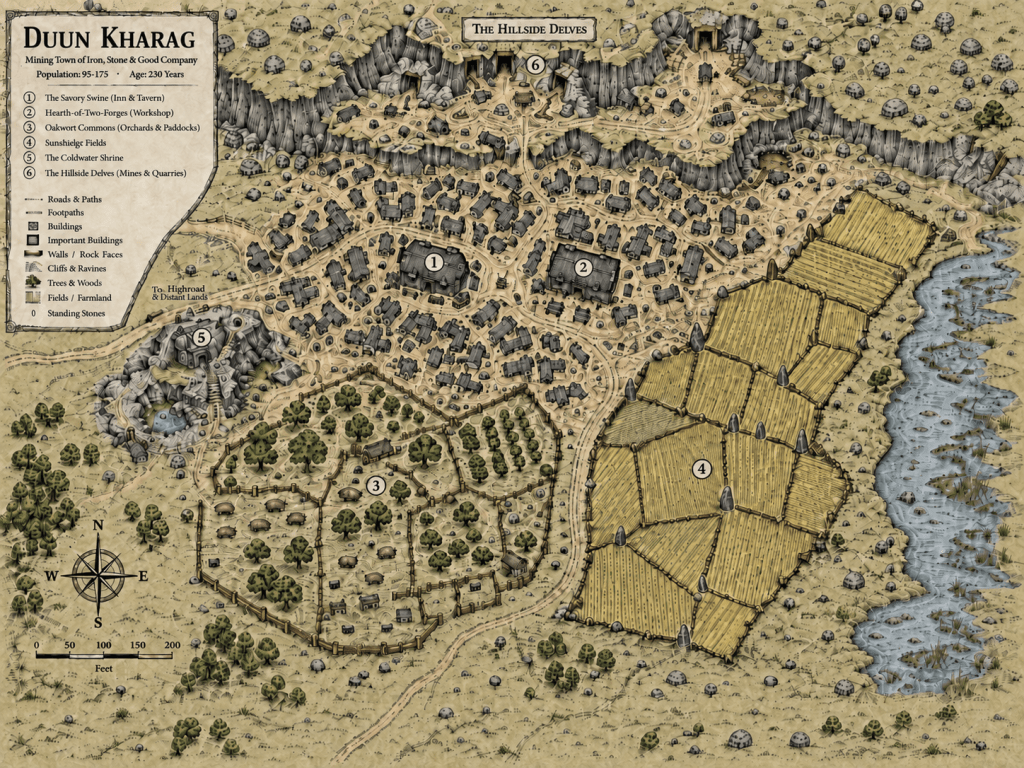
Population: ~95 (rising to nearly 175 after harvest or as mining needs grow)
Demographics: 55% Human (primarily Flan), 40% Dwarf, 5% Others
Province: Grimwold Marches
Overview
Duun-Kharag stands where the last dependable farmland of the Grimwold Marches gives way to the marsh-fed foothills of the Griff Mountains. Every spring, meltwater pours from the high peaks, flooding the low meadows before draining south into gentler grasslands. The land is stubborn, the growing season short, and every successful harvest is earned.
Unlike neighboring Rimehold, Duun-Kharag is no longer defined solely by mining.
The first dwarves came generations ago seeking iron, granite, and good building stone. As the richest seams diminished, many remained, discovering that while the mountains provided less each year, the foothills could support orchards, livestock, and hardy crops when worked alongside their Flan neighbors.
Today the hamlet is an uncommon partnership.
Flan families cultivate rye, barley, oats, beans, root vegetables, berries and orchard fruits, while dwarven households divide their time between shallow quarries, seasonal mining, stonecraft, and farming. Sheep and goats graze the higher slopes, while pigs root happily beneath the oak woods searching for mushrooms and truffles—foods the dwarves jokingly call “edible gems.”
Many still pretend such work is beneath them.
They become considerably less dismissive once the autumn hams have cured or a basket of fresh truffles reaches the dinner table.
The settlement reflects this balance. Timber farmhouses stand beside low stone cottages, dwarven homes disappear partially into the hillsides, and nearly every family keeps at least one foot in two different trades.
Life here is measured by seasons instead of production quotas. Planting, lambing, quarrying, harvest, and the first frost are all observed with equal importance.
Old Flan traditions remain deeply rooted. Standing stones mark ancient boundaries, offerings are quietly left beneath certain trees, and elders still speak blessings older than written history. Baron Ghalder’s encouragement of Pelor’s faith has been accepted politely rather than enthusiastically, creating a quiet coexistence rather than open conflict.
Travelers soon discover that Duun-Kharag welcomes honest labor, respects craftsmanship, and asks few questions—provided visitors show the same courtesy toward its customs.
Places to Go
The Savory Swine
Built around a glacial boulder that looks like a pig’s face predating the settlement itself, the ‘Swine serves as inn, tavern, and gathering place for nearly everyone in Duun-Kharag.
Its thick stone walls and low ceilings keep it warm through damp springs and bitter winters. Farmers arrive before dawn, quarrymen after work, and drovers whenever caravans pass through.
The menu favors simple fare: barley stew, smoked pork and pulled, roasted root vegetables, mountain cheeses, oat bread, and dark ale brewed with peat-smoked barley. The ouse speciality is a seasonal dish of plum pulled pork pies – one-handed food wrapped in dough that’s easily packed for miners. Come autumn, roasted pork with woodland mushrooms becomes the pride of the house.
Conversation is easy until it isn’t.
The proprietor, Baela Wrikeston keeps one simple rule:
“Leave old curses, relics, and holy arguments outside with your boots.”
Hearth-of-Two-Forges
One forge burns charcoal.
The other burns coal.
Together they represent the partnership that built Duun-Kharag.
Human blacksmiths and dwarven stoneworkers share this busy workshop, producing horseshoes, hinges, nails, farm implements, wagon repairs, and quarry tools. Larger commissions often become cooperative efforts, with each culture contributing its strengths.
The broad workyard frequently serves as neutral ground whenever disagreements between families require practical solutions.
Oakroot Commons
At the southern edge of the village spreads a patchwork of fields, orchards, grazing paddocks, and managed woodland shared by several families.
Among the oak groves wander the hamlet’s famously stubborn pigs, prized less for their meat than for their remarkable ability to uncover prized woodland truffles.
Every autumn, friendly rivalries erupt over whose animals discovered the finest “crop.”
Marshedge Fields
Beyond Oakroot Commons lie the flood-prone fields bordering the spring marshes.
Rye, barley, oats, beans, and turnips flourish once the waters recede, though every farmer keeps one eye on the mountains and another on the weather.
Ancient standing stones divide the fields. Officially they mark boundaries.
No one believes that is their original purpose.
The Coldwater Shrine
A quiet spring rises from beneath a weathered limestone outcrop where generations have paused for blessings before beginning long journeys or difficult work.
The shrine bears the sunburst of Pelor, yet older carvings remain beneath the newer stonework—worn spirals, flowing water, and harvest symbols left untouched by time.
Visitors are welcome.
Locals notice who leaves an offering.
The Hillside Delves
Though no longer the settlement’s primary livelihood, the shallow mines and quarries north of the hamlet continue to yield iron, granite, slate, and quality building stone.
Most workings are active only seasonally.
A handful of older tunnels remain sealed beneath heavy stone lintels carved with ancient dwarven runes whose meaning is politely summarized as:
“Leave sleeping stone alone.”
People to See
Torren Feldric
Hamlet Reeve
Practical, patient, and respected by both dwarves and Flan alike, Torren governs by quiet consensus rather than proclamation. He knows every family, every boundary dispute, and precisely when to let neighbors solve problems themselves.
Bruni Deepmantle
Master Mason
Bruni oversees the quarries, public buildings, and maintenance of the older dwarven delves. Though retired from full-time mining, he remains the settlement’s foremost authority on stonework.
He insists buildings should outlive their builders.
Most of his have.
Maelis Thornrow
Field-Warden
Keeper of the commons, orchards, grazing rights, and managed woodland, Maelis understands every ditch, stream, and marsh trail for miles around.
She also organizes the annual truffle hunt, an event taken far more seriously than outsiders expect.
Sister Elowen Brightwake
Keeper of the Coldwater Shrine
Young, sincere, and quietly compassionate, Elowen tends both travelers and villagers with equal care. Though devoted to Pelor, she has wisely learned that traditions centuries old are rarely changed by sermons alone.
She asks more questions than she answers.
Bram Tallowfoot
Swineherd & Woodland Forager
A cheerful Flan whose pigs are famous for finding exceptional truffles, Bram enjoys reminding dwarves that “the mountain never taught stone to taste this good.”
Even the loudest dwarven complaints usually end with requests for another helping.
Baela Stonewell
Proprietor of The Savory Swine
Short, broad-shouldered, and perpetually dusted with flour, Baela Stonewell keeps the Savory Swine running with remarkable efficiency and little patience for foolishness. A Flan by birth, she married the dwarven miner Durgan Stonewell years ago and has long since become as much a daughter of the dwarven quarter as the farming commons.
While Durgan spends his days beneath the hills working the seasonal delves, Baela feeds nearly everyone else. Travelers are welcomed with fresh bread, hot stew, dark ale, and the occasional slice of smoked ham if they’ve arrived before the miners clean out the kitchen.
Those who forget their manners quickly discover that Baela serves hospitality almost as quickly as she wields her well-worn rolling pin. More than one drunken quarryman has found himself escorted through the front door by a woman nearly half his size.
Baela hears nearly every piece of news that passes through Duun-Kharag. She is generous with local gossip, weather reports, and caravan news, but knows instinctively when a conversation has wandered into matters better left alone.
She has little patience for anyone who insults farmers, dwarves, or pigs.
“The pigs earn their supper,” she’ll say with a grin. “Can you say the same?”
Durgan Stonewell, her husband, works the Hillside Delves during the mining season and helps maintain stone walls, bridges, and field terraces when the mines are quiet. Most evenings he can be found at the far end of the common table enjoying his wife’s cooking while pretending not to hear the jokes about farmers that invariably end with requests for another helping of pork.
Harvuuk of the Standing Stones
Village Elder
Harvuuk, is old enough to remember more than one generation of dwarves and is respected by both communities. He rarely leaves the ancient stones overlooking the fields. He remembers family histories stretching back generations and recites proverbs whose meanings few fully understand.
When Harrek says a place should be left alone…even the dwarves pause.


Leave a Reply