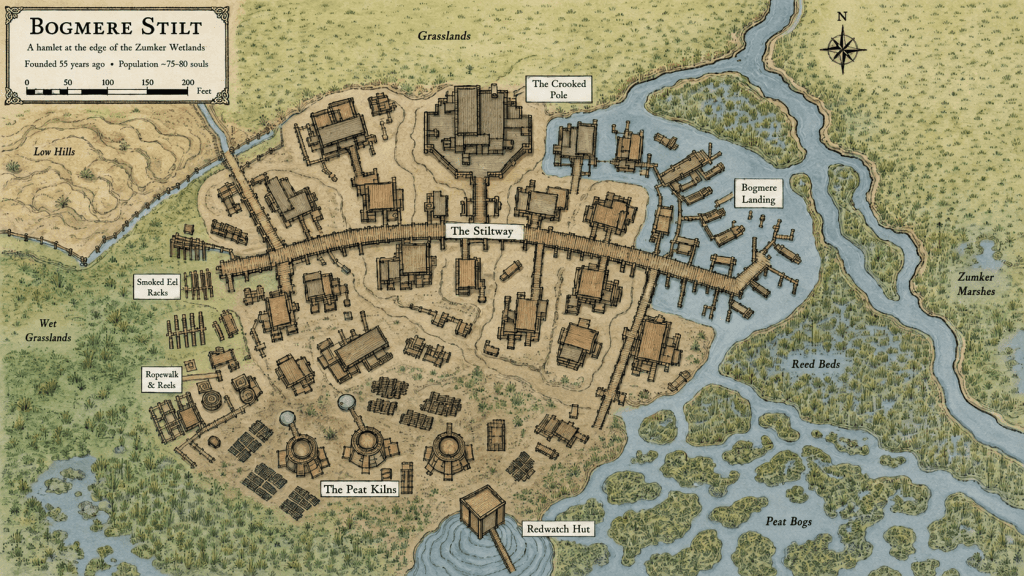
Bogmere Stilt is a wary river-marsh hamlet of roughly 75–80 souls, built on raised timber platforms at the edge of the Zumker wetlands. It lies 6 miles east of High Hadleigh and 9 miles south of Edgewatch, just beyond the last low hills before the land collapses into reed flats and mud.
The nearby Zumker River bends east-southeast before turning sharply north; the inside corner of this bend lies barely a mile from Bogmere. This curve slows the river, creating reed forests, silt bars, and narrow channels navigable only by flat-bottom boats and barges. Bogmere exists because of that bend—and survives because it knows the marsh better than anyone else.
The hamlet is permanently damp, perpetually misted, and smells of wet wood, peat smoke, and river mud. Buildings stand on stilts or earthen mounds faced with timber cribbing. Walkways of planks and rope bridges connect homes, docks, and store sheds, rising and falling with seasonal floods.
Places to Go
The Stiltway
A raised plank road running through the center of the hamlet, wide enough for handcarts and stretchers but never wagons. Hooks and poles line its edge for hauling goods from boats at high water.
Bogmere Landing
A cluster of crude docks and mooring posts hammered into packed mud and peat. Flat-bottom barges bring salt, iron tools, oil, and finished goods from High Hadleigh and Torven’s Ford; they leave with peat bricks, reeds, smoked eel, and marsh herbs.
Reedwatch Hut
A squat watch structure on the southern edge of the hamlet, manned by two to four locals at a time. It looks inland and riverward, not outward—its purpose is early warning of floods, strange lights, drifting carcasses, or unwanted visitors from the marsh.
The Peat Kilns
Low, smoking mounds of sod and turf where peat is dried and fired. The work is constant, slow, and dirty. Peat from Bogmere burns hot and clean enough to be valued upriver.
The Crooked Pole
Bogmere’s only tavern—more shelter than inn. It offers eel stew, riverbread, weak ale, and a dry loft for travelers willing to sleep above the mist. Outsiders are tolerated but watched.
People to See
Marta Fenlock, Stilt-Speaker
An older woman with a cane carved from driftwood. Marta acts as mediator, trade contact, and final word in disputes. She does not rule—she remembers. When Marta says a path is unsafe or a bargain is unwise, locals listen.
Hethan Marr, Barge-Master
Lean, sharp-eyed, and deeply practical. Hethan knows every channel and sandbar within ten miles. He will not sail at night, during heavy fog, or near certain reed clusters—no matter how much coin is offered.
Old Jorrek, Peat-Burner
Nearly deaf, perpetually soot-stained, and rumored to have survived three floods that should have killed him. Jorrek claims the marsh “warns those who hear it,” though he never explains how.
Sella Brimble, Herbalist
A quiet gatherer who supplies marsh herbs, poultices, and repellents. She knows which pools are safe and which are claimed. She never names the lizardfolk directly, referring to them only as “those who watch.”
Life in Bogmere
Bogmere survives through peat cutting, reed harvesting, fishing, eel smoking, and river guiding. Agriculture is minimal—small raised plots of onions, hardy greens, and marsh barley. Most food comes from river and trade.
The locals are cautious, not cowardly. They understand that the marsh is not evil—it is territory. A few scattered lizardfolk tribes dwell deeper in the reeds; most avoid Bogmere so long as boundaries are respected. When those boundaries are crossed, people vanish quietly.
Bogmere keeps no standing militia. Every adult knows how to pole a boat, move silently through reeds, and retreat when necessary. Warning bells and horn calls carry farther than shouts in the fog.
 Greywolf Comics & Media
Leave a comment