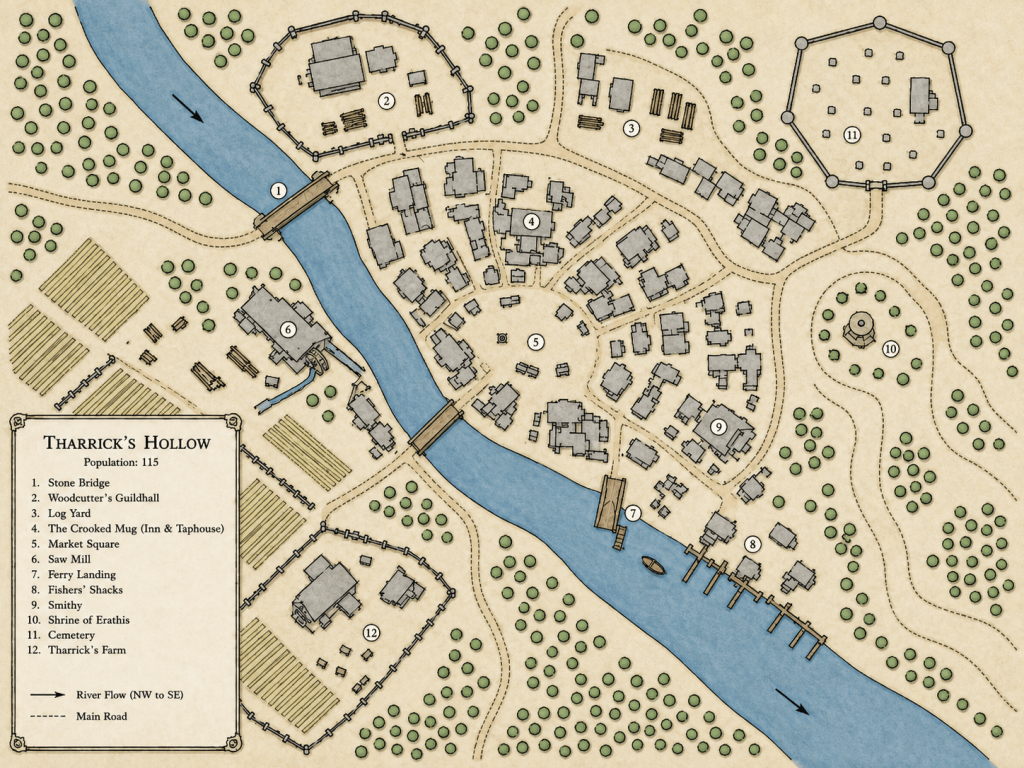
Hamlet, population approximately 110–125
85% Human, mostly Flan; 10% Halfling; 5% Other
Located on the east bank of the Zumkend River, southeast of Rutherton
Tharrick’s Hollow lies along a bend of the Zumkend River where wooded hills press close to the water, leaving a narrow shelf of fertile ground between the riverbank and the rising land to the east. A minor road connects the hamlet to the larger trade route approximately two and a half miles away, while the ferry provides access to the extensive forest on the western side of the river.
The Hollow began as a seasonal fishing and trapping camp but gradually became a permanent logging settlement. Its primary trade is timber cut from the forests across the river and floated downstream toward Rutherton and the larger markets of Tenh. Pine, fir, balsam, oak, birch, alder, and other northern and central woods are harvested according to their use and value. Straight softwoods are cut in quantity for beams, planking, construction, and river transport, while better hardwoods are selected for tools, wagons, bows, furniture, and specialty work.
The settlement also produces charcoal, resin, pitch, hides, smoked fish, game, herbs, and other forest products. Most families keep gardens, chickens, pigs, goats, or a few cattle, but the Hollow is not primarily an agricultural community. Tharrick’s Farm provides much of the hamlet’s grain, vegetables, fodder, and dairy.
The hamlet is named for Tharrick the Red, a Flan trapper, woodsman, and local folk hero said to have defended the early settlement from river trolls using fire, pitch, and a sharpened logging spear. A carved post depicting Tharrick stands near the ferry landing. It is not a shrine, although children paint the carving red each spring and woodcutters often touch the post before crossing the river.
Life in Tharrick’s Hollow is practical, seasonal, and closely tied to the river. Logging crews leave before dawn, the sawmill runs whenever the water permits, and the market becomes busiest when timber buyers and river traders arrive from Rutherton. Mist frequently gathers over the water and in the low gullies east of the settlement. Beyond the cut trails, the forest remains largely unsettled.
The Hollow has little formal authority. Most disputes are settled by the senior elders, the Woodcutter’s Guild, or the families responsible for the ferry and river traffic. The people are accustomed to hunters, trappers, traveling merchants, scouts, and adventurers, provided visitors pay their debts and do not create problems the settlement must solve after they leave.
Recent concerns include missing cutters, damaged logging marks, animals driven from familiar ranges, unusual tracks near the river, and increasingly frequent sightings of lizardmen in the forest to the south and west.
Places to Go
1. Stone Bridge
A low, broad stone bridge crosses a narrow stream and drainage channel just before it empties into the Zumkend. The main road into the Hollow passes over it before reaching the market square and riverfront.
The bridge is older than most of the settlement. Its lower courses may be Flan work, although sections have been repaired many times with local stone and timber. During heavy rain, water backs up beneath the bridge and floods the low ground nearby.
Travelers approaching from the trade road usually enter the hamlet here.
2. Woodcutter’s Guildhall
The Woodcutter’s Guildhall is a long timber building used by cutters, foresters, log drivers, trappers, and river hands. It serves as hiring hall, meeting place, storehouse, and informal seat of village authority.
Rough maps of the western forest hang from the walls. These show logging claims, cutting paths, hunting trails, old camps, dangerous gullies, and places marked only with warnings. Work notices, missing-person notices, timber prices, and offers of reward are posted beside the door.
A cracked logging spear hangs above the main hearth in memory of Tharrick the Red.
The guild maintains communal equipment, organizes larger cutting crews, settles disputes over timber claims, and may hire adventurers when ordinary woodsmen are unwilling to investigate a problem.
3. Log Yard
The log yard is the largest open area in Tharrick’s Hollow and the center of its economy. Timber brought across the river is sorted, trimmed, branded, measured, and prepared for transport.
Softwood logs are usually bound into rafts or released in controlled runs downstream. Heavy hardwoods may be cut into shorter lengths or loaded onto barges. Each family or timber concern has its own mark burned into the end of the logs.
The yard is filled with stacked timber, drag chains, wedges, peaveys, ropes, sledges, and long poles used by the river crews. During the spring thaw and autumn cutting season, the yard operates from before sunrise until dark.
Log jams, broken chains, rolling timber, and sudden changes in the river make it one of the most dangerous places in the hamlet.
4. The Crooked Mug
Inn and Taphouse
The Crooked Mug is a low, heavily built inn facing the market square. It is the usual gathering place for woodcutters, ferrymen, hunters, traders, and travelers passing through the Hollow.
The common room is warm, smoky, and rarely quiet after sunset. The inn serves dark ale, small beer, bitterroot wine, herbal teas, smoked fish, venison stew, oat bread, and a thick hunter’s pie made from whatever meat is available.
The building contains a small number of private rooms, a larger loft shared by travelers, and a fenced yard for pack animals. During logging season, every bed may be occupied.
Mivven Kell keeps several medicinal teas and herbal preparations behind the bar. Some are sold openly. Others are provided only when she believes they are needed.
5. Market Square
The market square is a hard-packed open area between the Crooked Mug, the guildhall, and the road leading to the riverfront.
The Hollow does not support a full daily market. Most local trading occurs informally, while a larger market gathers when merchants arrive from Rutherton or when a major timber shipment is being assembled.
Common goods include smoked fish, hides, pelts, charcoal, resin, pitch, herbs, honey, mushrooms, simple wooden goods, rope, lamp oil, grain, vegetables, livestock, and used tools. Timber contracts and employment agreements are also negotiated here.
Visiting merchants may bring salt, iron, cloth, pottery, wine, finished tools, and other goods the hamlet cannot produce for itself.
6. Saw Mill
The sawmill stands close to the river where a narrow mill channel feeds a large waterwheel. It produces rough planks, beams, shingles, poles, and wagon timber.
The mill does not generally make furniture or finished decorative goods. Its purpose is to reduce bulk timber into useful building material before shipment. Better pieces of hardwood are set aside for sale to craftsmen elsewhere.
The mill can be heard throughout much of the hamlet when it is operating. Sawdust collects in deep banks along the rear of the building and is used for bedding, fuel, packing, and charcoal production.
Breakdowns are common, and replacement iron fittings must usually be ordered from Rutherton.
7. Ferry Landing
A broad rope-guided ferry crosses the Zumkend to the western forest. It carries cutters, wagons, oxen, hunters, livestock, and occasional merchants.
The ferry is maintained by several of the Hollow’s founding families, who take turns operating it and collecting tolls. Ordinary residents crossing on village business are rarely charged, while outsiders usually pay one silver piece per group, wagon, or mounted party.
Crossings may be suspended during floods, heavy ice, dense fog, or reports of dangerous creatures in the river.
The carved post of Tharrick the Red stands near the landing, weathered smooth by generations of hands.
8. Fishers’ Shacks
The fishers’ shacks are the oldest inhabited part of the settlement. They stand along the lower riverbank on short pilings, with nets, eel traps, small boats, and drying racks clustered around them.
Fishing supplements the hamlet’s food supply rather than supporting a major export trade. Common catches include eel, catfish, river trout, crayfish, mussels, and seasonal runs of smaller fish.
Several families also hunt river fowl and gather reeds, edible roots, and medicinal plants from the shallows.
The fishers are often the first to notice changes in water level, current, fish behavior, or movement along the opposite bank.
9. Smithy
The smithy is a practical working forge serving the logging and farming community. Most of its work involves axes, saw teeth, wedges, chains, hooks, nails, horseshoes, wagon fittings, trap parts, and repairs to mill machinery.
Simple knives, spearheads, arrowheads, and agricultural tools can also be made or repaired. Fine weapons, armor, and complex metalwork must be commissioned elsewhere.
The smith keeps a small supply of ordinary arms suitable for hunters and militia service, but the Hollow is not a place where adventurers can expect to purchase rare or superior equipment.
10. Shrine of Erathis (& Beory)
The shrine is dedicated to Erathis, goddess of civilization, law, community, and the works of mortal hands. Her worship is unusual in this predominantly Flan region, where devotion to Beory is far more common, but the people of Tharrick’s Hollow see no contradiction in honoring both.
Beory represents the land that sustains them. Erathis represents the settlement they have built upon it.
The shrine consists of a low stone enclosure surrounding an old tree whose roots have grown through the foundation. A shallow basin catches rainwater and river water brought by worshippers. The enclosure is marked with simple carvings of roads, walls, bridges, tools, and joined hands rather than elaborate religious images.
Offerings commonly include nails, carved wooden tokens, small lengths of cord, river stones, grain, resin, and the first sound piece cut from a newly felled tree. Woodcutters may leave a shaving from a repaired axe haft, while ferrymen sometimes place a bent coin or worn rope knot beside the basin after a dangerous crossing.
The shrine teaches that civilization is not the destruction of the wilderness, but the careful ordering of human life within it. Forests may be harvested, roads built, rivers crossed, and homes raised, but such work carries responsibilities. Timber should not be wasted, claims should be honored, bridges maintained, and the needs of the settlement placed above private greed.
The shrine also serves a practical civic purpose. Contracts may be witnessed there, apprentices accepted into a trade, disputes formally settled, and new buildings blessed before occupation.
A local keeper tends the shrine, conducts seasonal observances, blesses logging camps, tools, bridges, and new construction, and performs marriages and funerary rites.
11. Cemetery
The cemetery lies on a low rise overlooking the river. Most graves are marked with carved wooden posts rather than stone, although several older families have small cairns or flat stone markers.
Many of the markers bear simple symbols: an axe for a woodcutter, a fish for a river family, a sheaf for a farmer, or a spear for someone who died defending the settlement.
Empty markers commemorate those lost in the forest or river whose bodies were never recovered. By custom, these face west toward the Zumkend and the wilderness beyond.
The oldest graves are clustered near a large weathered oak. Some appear to predate the permanent settlement.
12. Tharrick’s Farm
Tharrick’s Farm occupies the most open and fertile ground east of the hamlet. Local tradition holds that the original holding belonged to Tharrick the Red, although the present buildings are much newer.
The farm produces oats, barley, root vegetables, apples, fodder, milk, eggs, and some meat. Several smaller households work portions of the surrounding land in exchange for access to the farm’s barns, plow teams, and storage sheds.
The farm also keeps oxen used by the logging crews. During major timber operations, these animals are ferried across the river to drag logs from the cutting sites.
The current family claims descent from Tharrick, although whether this is literally true matters less to the villagers than their continued stewardship of the land.
People to See
Mivven “Miv” Kell
Keeper of the Crooked Mug, Herbalist and Midwife
Mivven Kell is a quiet Flan woman in her middle years who traveled for many years as a healer and midwife before settling in Tharrick’s Hollow.
She manages the Crooked Mug with a calm efficiency that makes even the most difficult loggers lower their voices around her. She prepares herbal teas, salves, poultices, fever remedies, and treatments for bites, stings, infected wounds, and exposure.
Mivven listens more than she speaks and remembers nearly everything said in her common room. She rarely repeats a confidence directly, but she has a way of guiding people toward information they need.
She says little about why she stopped traveling except that she had “seen enough roads end badly.”
Nohan Thatch
River Master and Senior Elder
Nohan is a broad, heavyset man with a thick beard, weathered skin, and the permanent sunburn of someone who has spent most of his life on the river.
He supervises the ferry, log runs, raft assembly, and the timing of major timber shipments. He can read the Zumkend’s currents, depth, weather, and seasonal changes better than anyone in the Hollow.
Nohan is practical, cautious, and difficult to impress. He is not opposed to risk, but he has little patience for unnecessary danger.
He has recently become concerned about changes in the river. Sandbars are forming in unfamiliar places, fish are avoiding certain channels, and more debris is arriving from the south than the current should carry.
Wadmyr Tharrick
Master of the Woodcutter’s Guild
Wadmyr is a large, deliberate man considered a descendant of Tharrick the Red, although no one can produce a complete family record proving it.
He oversees timber claims, cutting crews, forest camps, and the maintenance of communal logging equipment. Wadmyr believes the Hollow can continue to prosper only if the forest is harvested carefully and allowed time to recover.
He frequently argues with merchants and buyers who want greater production, but he is not sentimental about the wilderness. He understands that the hamlet survives by cutting timber. His concern is whether it will still have timber to cut twenty years from now.
Wadmyr is one of the most likely people to hire adventurers to investigate missing crews, damaged camps, dangerous animals, or trouble in remote cutting areas.
Tessik and Holva Darn
Twin Trappers, Hunters and Forest Guides
Tessik and Holva are sharp-eyed Flan siblings who spend more time in the forest than in the settlement.
They scout new timber stands, mark safe approaches, trap for fur, guide hunting parties, and search for valuable hardwoods. They speak in short, unfinished phrases and often seem to know what the other is thinking.
The twins know old trails, abandoned camps, ruins, animal ranges, and several hidden crossings along the river. They also know places they refuse to enter.
They once returned from a week in the forest carrying no game, no traps, and only one of their two axes. Neither has explained what happened.
Samel Greel
Former Border Scout and Storyteller
Samel is an aging former soldier and frontier scout who lives in a crooked cottage near the river.
He spends many evenings at the Crooked Mug telling stories of old Flan wars, river trolls, haunted ruins, lost patrols, and dangerous things in the forest. Some of his stories are accurate, some are exaggerated, and some are complete inventions.
Samel is more useful than he appears. He remembers old roads, military camps, abandoned watch posts, and border trails no longer shown on modern maps.
When he stops joking about a particular story, the locals pay attention.
Della Marris
Fishmonger and Smokehouse Keeper
Della is a blunt, practical woman who purchases much of the local catch and manages the smoking and storage of fish and game.
She knows which parts of the river are safe, which families exaggerate the size of their catches, and where the water has recently begun to behave strangely.
Della has stopped buying fish from one stretch of river south of the settlement. She says the flesh is soft, the eyes are cloudy, and the animals in the shacks refuse to eat it.
She and Nohan disagree frequently, mostly because each believes the other is overlooking something important.
Lethra Fen
Halfling Teamster and Animal Keeper
Lethra manages the hitching yard and cares for many of the oxen, draft horses, and pack animals used by the hamlet.
She is patient with animals and guarded with people. She pays close attention when livestock refuse to cross a bridge, enter the ferry, drink from the river, or continue along a forest trail.
Lethra knows most of the roads and cart paths between the Hollow and the trade route. She also arranges wagons, teamsters, and pack animals for travelers who can pay.
Several weeks ago, one of her best oxen panicked near the western forest and broke its harness trying to return to the ferry.
Edran Pike
Timber Factor and Merchant’s Agent
Edran represents several timber buyers in Rutherton and farther downstream.
He is well dressed by the standards of the Hollow, keeps careful records, and knows exactly how much each species and grade of timber is worth in larger markets.
Edran pushes the guild to increase production and open new cutting areas. He argues that demand is rising and that the Hollow must take advantage of the opportunity before other settlements do.
He is not openly cruel, but he is willing to accept risks that local woodcutters must personally face.
Edran frequently hires guards, scouts, and adventurers when a profitable shipment or timber claim requires protection.
Jalluk Tobrin
Blacksmith
Jalluk is a thick-armed, impatient smith whose hearing has been damaged by years at the forge.
He repairs logging tools, mill fittings, chains, wagon hardware, traps, farm implements, and ordinary weapons. He takes pride in making an axe hold its edge and has little interest in decorative metalwork.
Jalluk hears much of the hamlet’s news because nearly every working family eventually brings something to his forge.
He has recently repaired several axes damaged by cuts that looked less like ordinary wood grain and more like the tools had struck stone hidden inside living trees.
Yanna Fulbrook
Keeper of the Shrine of Erathis
Yanna is an older Flan woman who tends the shrine, cemetery, and several small community gardens. Her devotion to Erathis is unusual in a region where Beory remains predominant, though Yanna does not see the two faiths as rivals. She teaches that Beory gives the land, while Erathis teaches people how to live together upon it.
She performs marriages, funerals, blessings of tools and new buildings, apprentice oaths, and seasonal observances connected to planting, harvest, logging, bridge maintenance, and the river. Agreements witnessed before her carry considerable weight in the Hollow, even when no formal law requires them.
Yanna does not oppose the cutting of trees or the expansion of the settlement. She believes the work of civilization is honorable when it is disciplined, useful, and undertaken for the good of the community. Waste, neglected roads, unsafe structures, dishonest contracts, and the reckless exhaustion of shared resources offend her far more than logging itself.
She has become increasingly critical of crews cutting deeper into the western forest without maintaining trails, marking boundaries, or restoring damaged ground. In her view, the problem is not that the forest is being used, but that some people are beginning to take from it without accepting responsibility for what they leave behind.
Recently, tools blessed at the shrine have broken unexpectedly, and several offerings left before major logging expeditions have been found scattered outside the enclosure by morning. Yanna is unsure whether this is a warning from Erathis, interference by someone in the hamlet, or evidence that the settlement’s agreements are beginning to fail.
Rusk Tharrick
Farmer and Keeper of Tharrick’s Farm
Rusk is the current head of Tharrick’s Farm and claims direct descent from Tharrick the Red.
He is a capable farmer, ox handler, and organizer who provides much of the grain, fodder, and draft power used by the settlement. He is respected but sometimes resented because many families depend upon his barns and animals.
Rusk treats the Tharrick legend as a family responsibility rather than a reason for special privilege.
He possesses several old tools, journals, and pieces of family lore associated with the founding of the Hollow. Most are probably ordinary. At least one may not be.


Leave a Reply