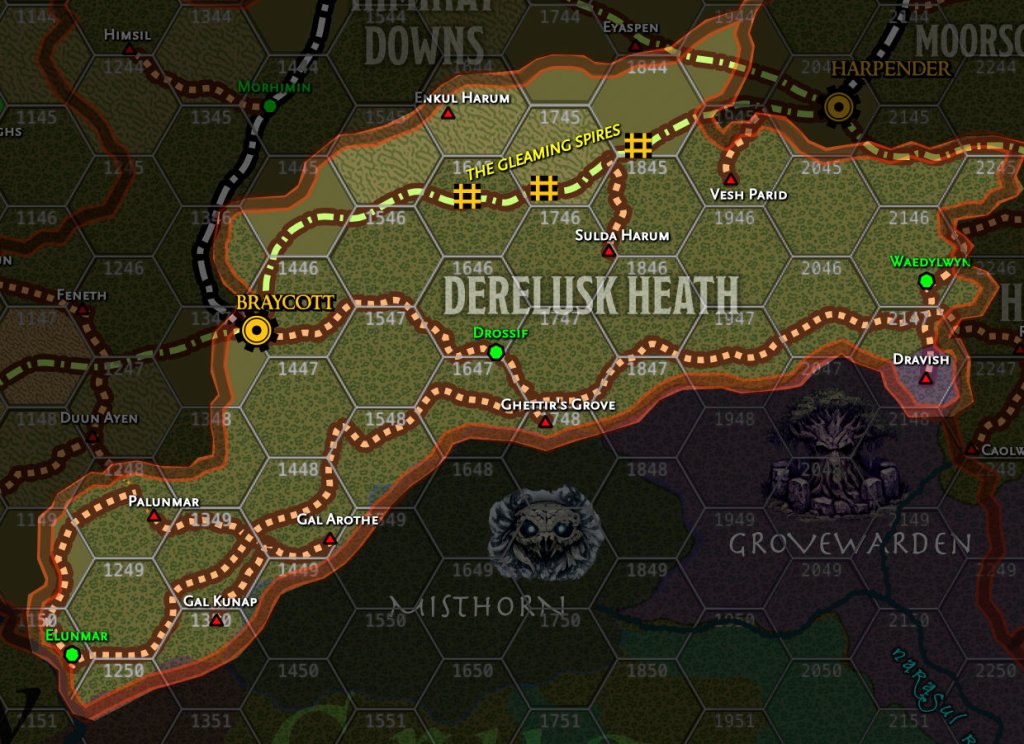
Derelusk Heath forms the southwestern-southern frontier of the Duchy of Tenh, stretching east-to-west along the outer reaches of the ancient Phostwood. Though called a “heath” in older records, nearly eighty-five percent of the province is now consumed by dense forest, tangled woodlands, and dark overgrowth pressing northward from the Phostwood’s interior. Only the northwestern reaches near Braycott retain broad farmlands and open grazing country.
The province exists in a constant state of uneasy balance between civilization and encroaching wilderness.
Baron Cyran Volgrave (Vhol’garav)
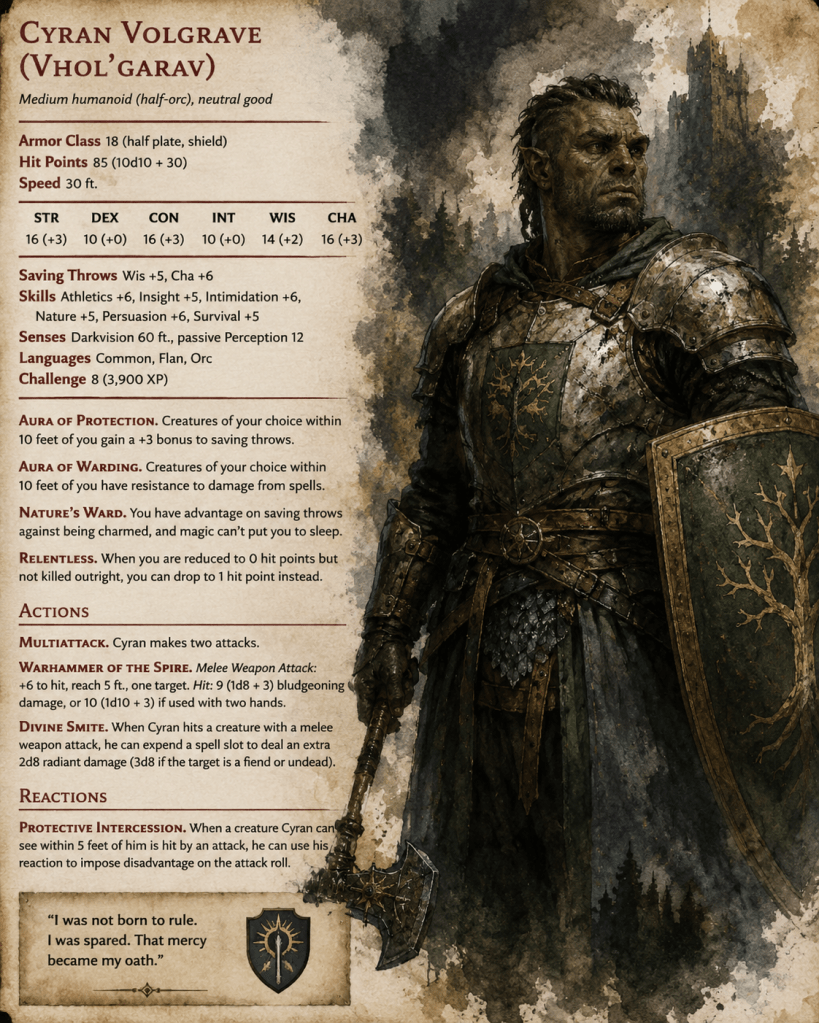
Baron Cyran Volgrave, born Cyran Vhol’garav, is the half-orc son of a displaced southern tribal warrior whose people were destroyed during the violent border conflicts along the Phostwood decades ago. He was found as a child by riders of the Pelorian Wardens of the Last Light, a frontier order tasked with protecting the southern roads and settlements of Tenh. Raised among cavalry patrols, shrine-forts, and displaced Flan families, Cyran grew up shaped by both the teachings of Pelor and the old Flan reverence for Beory and the living land. Though mistrusted by many in his youth, he earned respect through discipline, humility, and steadfast service along the dangerous southern frontier.
As Baron of Derelusk Heath and Guardian of the Gleaming Spires, Cyran is known for practical leadership, stern mercy, and an unshakable sense of duty. He works constantly to keep peace between the province’s half-elven and half-orc communities while maintaining the fragile border with the Phostwood tribes. Cyran opposes reckless expansion into the forest but responds swiftly to raids or threats against the Duchy. Quiet and deliberate, he believes strength exists to preserve civilization, not dominate it.
Geography & Borders
The southern border of Derelusk Heath touches lands claimed by the Misthorn and Grovewarden Grugach tribes, isolationist wild elves who dwell deep within the Phostwood. Though the Grugach rarely emerge openly into Tenh territory, they consider much of the southern forest sacred ancestral land and react violently to perceived encroachment.
Neither side officially acknowledges war, yet blood has been shed along the border for generations.
The provincial capital of Braycott sits at the junction of several major roads and serves as the military and administrative heart of the province. Its cavalry garrison patrols the southern trade route and reinforces the chain of ancient fortresses known collectively as The Gleaming Spires.
These three towering keeps predate the modern Duchy and are believed to have been raised atop much older Ur-Flan foundations. Built from a strange volcanic-glass flecked basalt, their walls catch and scatter sunlight at dawn and dusk, causing the towers to shimmer with silver-gold reflections visible for miles through the forest haze.
Travelers often describe the effect as “like watching the forest itself catch fire.”
The Spires serve as:
- reserve military bastions,
- anti-incursion strongholds,
- signal relay towers,
- and staging points for rapid cavalry deployment.
Though formidable, they are not merely defensive structures. Ancient glyph-work and buried stoneworks beneath the fortresses suggest whoever built them may have intended them as warding sites against something deeper within the forest – others whisper the fortresses are built to keep an ancient evil imprisoned.
The Phostwood
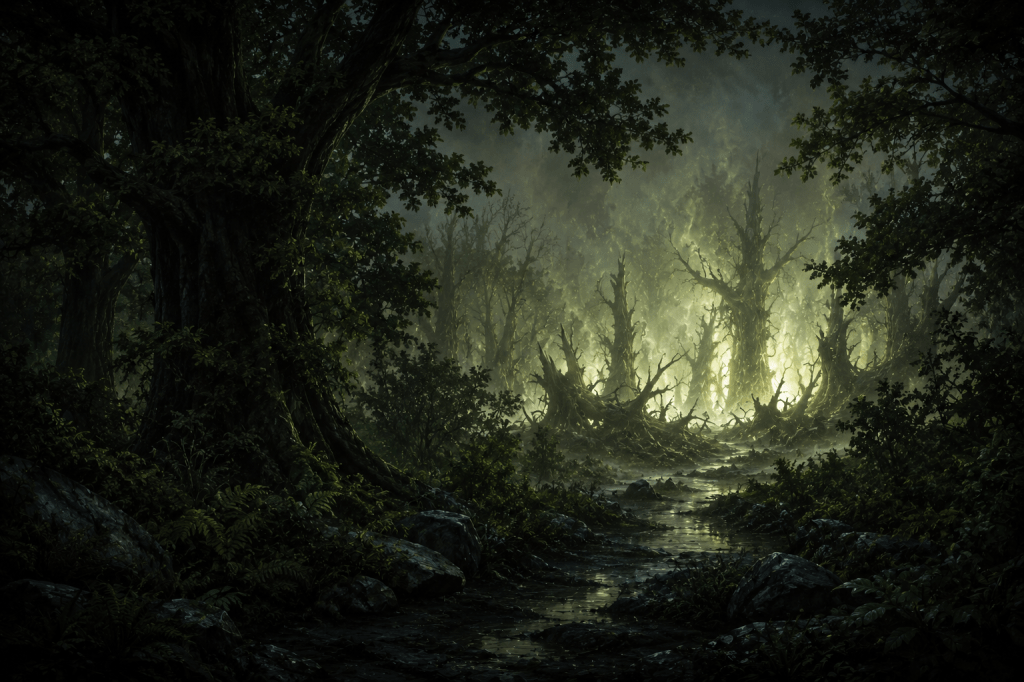
The Phostwood dominates life in Derelusk Heath.
Towering Phost trees, found nowhere else in the Duchy, produce pale bioluminescent glows after death. Entire dead groves may emit faint ghostly light beneath fog or rain. The wood itself is notoriously difficult to preserve; it resists drying, warps unpredictably, and often decays despite magical treatment.
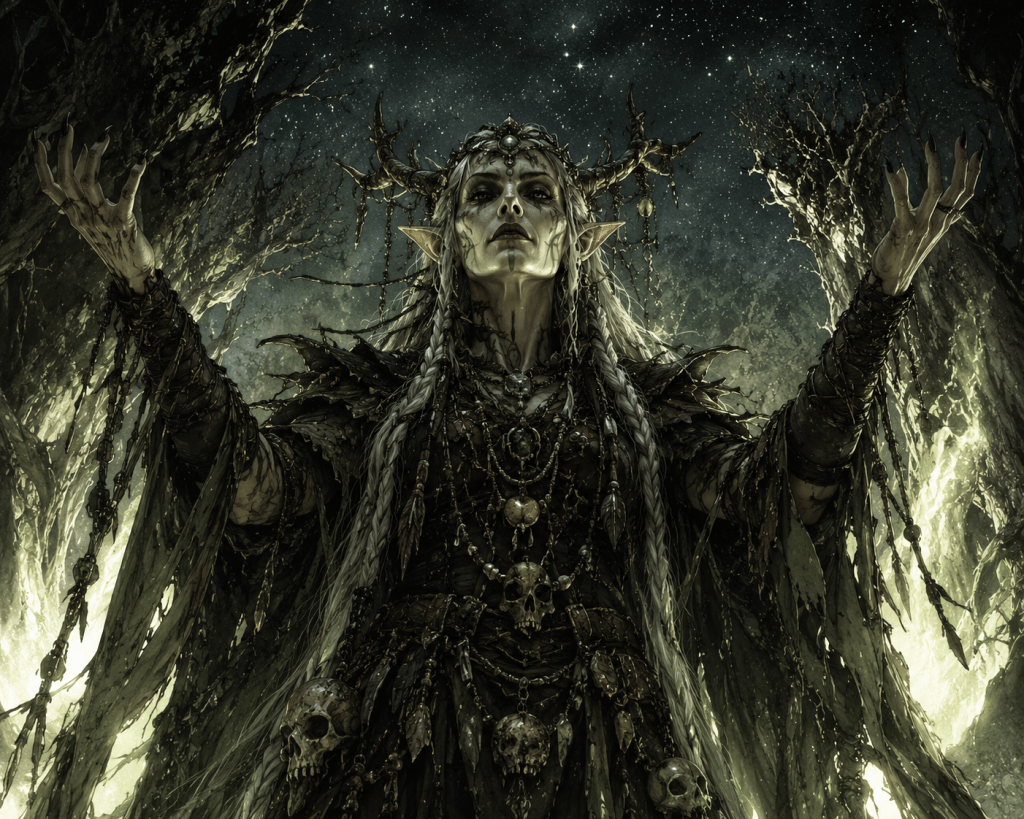
Many locals consider the trees semi-sacred, and there are Grugach witches’ ward-runes warning would-be loggers, fortune-seekers, and troublemakers to keep their distance. Stories of ruined shrines, collapsed watchposts, and ancient stoneworks hidden beneath roots suggest that attempts to tame or understand these woods have so far failed.
Peoples of the Heath
Though predominantly Flan, Derelusk Heath possesses one of the Duchy’s most diverse frontier populations.
Elves & Half-Elves
Half-elves are notably more common here than elsewhere in Tenh, particularly in:
- Elunmar
- Palunmar
- and Braycott itself.
Rumors persist that some families possess distant Grugach ancestry, though such claims are rarely spoken openly.
Many half-elves serve as:
- scouts,
- foresters,
- negotiators,
- herbalists,
- and guides along the southern roads.
Half-Orcs
The southwestern settlements contain unusually high half-orc populations.:
- Enkul Harum
- Gal Kunap
- Gal Arothe
- along with Ghettir’s Grove and Drossif
Most scholars believe these communities emerged after violent Grugach campaigns against southern orc tribes thirty to fifty years ago. What happened afterward is fiercely disputed:
- some claim fleeing orcs absorbed abandoned human survivors,
- others insist desperate raiders pillaged collapsing settlements,
- and a few suggest the Duchy quietly resettled survivors to stabilize the border.
Every side tells a different version.
The result is a frontier culture where half-orcs and half-elves—both treated as outsiders by many—often cooperate uneasily out of necessity.
Trade & Industry
Despite its dangers, Derelusk Heath is economically valuable.
Major exports include:
- lumber,
- ironwood,
- medicinal herbs,
- leather,
- furs,
- smoked game,
- forest resins,
- and rare alchemical ingredients.
A few small copper and silver mines operate in the western wooded hills, though they are usually heavily guarded with mercenaries or soldiers.
A thriving black market also exists, dealing in: poisons, venoms, rare fungal compounds, Grugach tinctures, and illicit items.
Politics & Tensions
Officially, the Duchy maintains peace with the Grugach tribes.
Unofficially, the border remains one bad season away from open bloodshed.
The Baron of Harthold’s Reach is rumored to maintain a private truce with at least one Grugach matriarch, enforced quietly through ranger channels and the Cern Vatha. Yet not all coven-mothers support this arrangement, and younger warbands increasingly test the border.
Likewise, not all in Braycott favor restraint. Some believe the forest dwellers should be permanently driven back. Others fear such an attempt would awaken forces older and far worse than the Grugach themselves.
The Low Road Company
The Low Road Company is a loose but respected network of scouts, caravan wardens, guides, bounty hunters, and frontier operatives working throughout the southern reaches of Tenh. Along the roads of Derelusk Heath and the shadowed borders near the Phostwood, their members are often the difference between a caravan arriving safely or vanishing into the trees. They hire sellswords, trackers, woodsmen, locksmiths, outriders, trappers, and those with talents best left unspoken of in polite company. Though small in number, the Company maintains contacts in nearly every major settlement south of Oxton, and it is rare to find a village without at least one person who knows how to quietly pass word to them.
Officially, the Low Road Company exists to keep trade moving where soldiers cannot always patrol and where the dangers of the frontier change faster than any lord can react – for a price. Unofficially, they are known to settle disputes (or start one), recover stolen goods, silence raiders, escort questionable cargo, and occasionally make troublesome people disappear beyond the forest roads. The Company asks few questions so long as coin is good and the work does not threaten the status quo of the southern provinces. Many members are outcasts, half-breeds, wanderers, or veterans who found little place elsewhere, and loyalty within the Company tends to run deeper than law or title.
Among darker circles there are whispers of an inner order known only as the Ashmark. Few know whether it truly exists or is merely a story used to frighten fools and loose-tongued brigands. Supposedly, the Ashmark handles the work the Low Road Company never speaks of openly: assassinations, sabotage, infiltration, and quiet killings along the border roads and forest trails. Some claim its members mark themselves with ash from burned settlements or carry charcoal-black brands hidden beneath their armor. Others say if the Ashmark has taken interest in someone, that person has already been judged long before the knife is drawn.


Leave a Reply