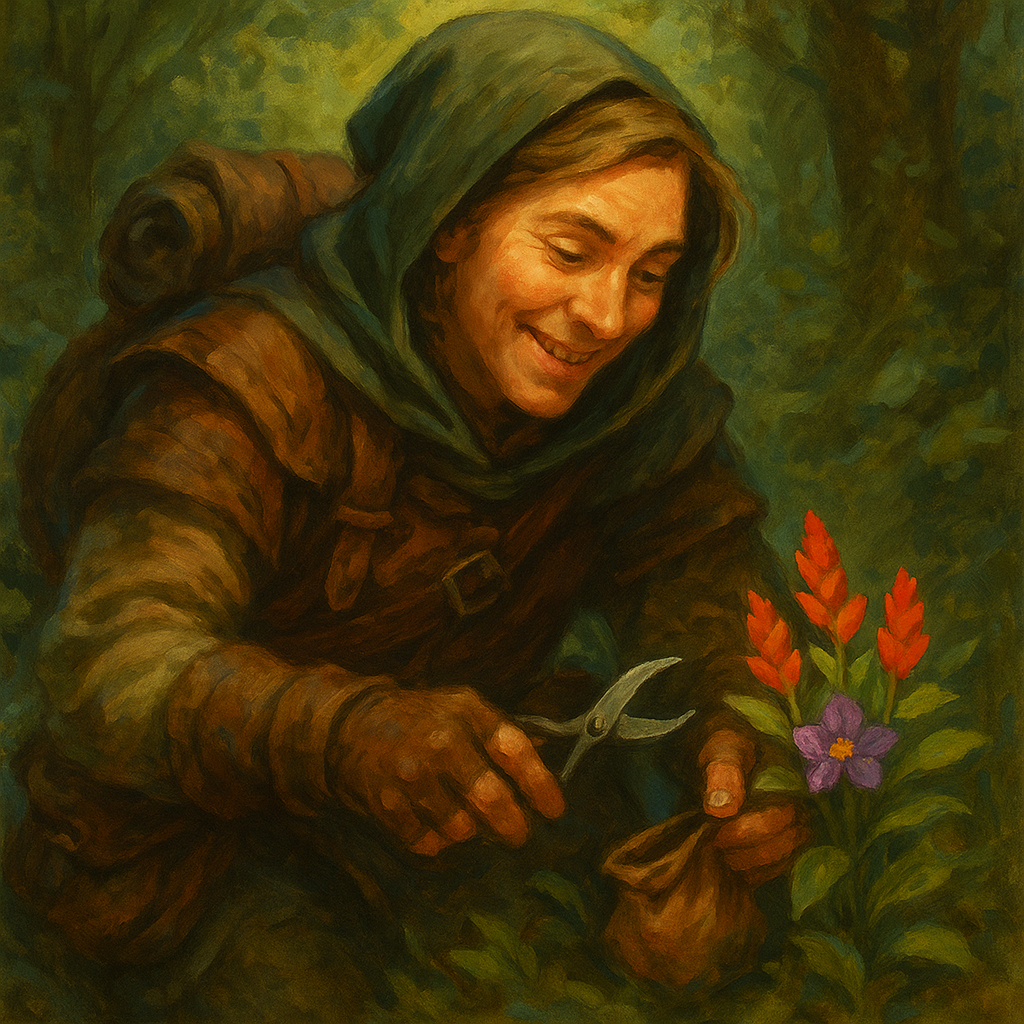
In D&D5e there aren’t an explicit set of rules for crafting. Now, I’ve been a bit spoiled playing World of Warcraft (WoW) for well over 15 years and found the original or ‘Classic’ system of crafting to be a well designed system. Without boring you on game mechanics or time-to-power investment, I’ve cobbled together a basic system that allows players some agency if they’re inclined to do a bit of field research and foraging.
This is broken into two pages or sections:
- Herbalism as a system and how it works (this page)
- Herbs and where to find them, gather them, what they do, and recipes for common D&D potions
- I also have an Enchanting version of this as crafting magic items was never really defined. While there are some excellent resources out there that expand the topic, they still fall short of providing a DM a ready-made ‘Out of the Box’ system players can begin to explore.
Overview
The Herbalism system has three major considerations:
- Properties – thematic classification of plants, by their properties or use and is inspired loosely from the 2e schools of magic.
- Climate – determines where a plant can typically be found. A plant will have a prime climate, where it normally grows. Plants can appear in other climates, however, each degree of separation increases its rarity. For example: an herb that grows in Temperate climate and is Common, will be Uncommon in Sub-Temperate climes, and Rare in Arctic/Tropical.
- Rarity / Potency – determines how much plant is needed and how effective it is. This is also affected by the Herbalist’s level/skill.
Properties / Magical Uses
Herbs are organized into eight areas based on their properties and how they help/harm. While their properties among all but the rarest and legendary are natural, somehow the process of concoting a potion, exilir, decoction, etc. augments its capabilities beyond the normal abilities of an apothecary:
| Affinity / “School” | Theme | Example Plant Uses |
|---|---|---|
| Vitalis (Restoration) | Healing, vitality, purification | Healing draughts, poison cures, restoratives |
| Venin (Toxins) | Poison, rot, necrosis | Paralytic venoms, weakening agents, disease |
| Ignis (Energy) | Fire, heat, vigor | Potions of haste, fiery oils, stimulants |
| Gelum (Calm/Cold) | Cold, clarity, stasis | Potions of heroism, clarity of mind, ice effects |
| Umbra (Shadow/Spirit) | Darkness, dreams, spirit world | Sleep draughts, necrotic infusions, ethereal effects |
| Lux (Light/Order) | Sun, radiance, protection | Blessing oils, anti-undead tonics, radiant poultices |
| Sylva (Growth/Nature) | Plants, earth, resilience | Barkskin elixirs, entangling resins, natural armor |
| Aether (Mind/Arcane) | Insight, illusion, wild magic | Potions of intellect, wild surges, invisibility agents |
Climate
There are four basic climate tiers. You can, of course, expand and adjust to fit your campaign:
| Climate Tier | Example Biomes | Notes |
|---|---|---|
| Arctic | Tundra, taiga, glaciers | Short growing season, plants are often potent but rare. |
| Temperate (Sub) | Northern forests, highland plains | “Cool temperate” regions, like Canada or Northern US. |
| Temperate | Mixed forest, river valleys, farmland | Abundant diversity, most common herbs are here. |
| Tropical | Jungles, wetlands, savannah | Extremely potent plants, many toxic, year-round growth. |
Rarity/Potency
| Rarity | Gather DC | Quantity Needed | Effect Strength |
|---|---|---|---|
| Common | 10 | 3 doses per brew | Minor effect (e.g. 1d4 healing, or +1 on a check) |
| Uncommon | 15 | 2 doses per brew | Moderate effect (e.g. 2d4 healing, advantage on save) |
| Rare | 20 | 1 dose per brew | Strong effect (e.g. 4d4 healing, resistance for 1 hr) |
| Very Rare | 25 | 1 dose (hard to find) | Major effect (e.g. lesser restoration, 1/day use) |
| Legendary | 30 | Unique | Quest item, permanent or story-level effect |
Leveling Herbalism Skill
If your players want to learn Herbalism, they can be trained as an apprentice; if you want them to have accomplished this skill outside of sessions, I’d recommend it (no different than an adventurer having learned a language or two).
If you’d prefer to offer it, I recommend having an NPC who is an Herbalist or is a Druid, Ranger, or Cleric class of at least 3rd level. Training an apprentice can either be done between sessions (taking a week to get the basics).
Herbalism, like most skills, requires practice and the benefits of practice are experience points (XP). Acquiring enough XP will grant a level of skill. Higher levels of skill provide improved benefits or new abilities. Players will start at Level ‘0’ with 0 XP and need to gain 10 XP to get their first benefit at Level 1, a +1 on gathering rolls.
Each successful gather = 1 Herbalism XP (even if plant is Common).
| Level | Adjusted XP Needed | Bonus Gained |
|---|---|---|
| 1 | 10 | +1 to gather rolls |
| 2 | 20 | Gain proficiency bonus if not already proficient with Nature |
| 3 | 40 | Advantage on Common & Uncommon plant gathers |
| 4 | 50 | +1 to gather rolls (total +2) |
| 5 | 68 | Advantage on Rare plants |
| 6 | 90 | +1 to gather rolls (total +3) |
| 7 | 120 | Advantage on Very Rare plants |
| 8 | 150 | +1 to gather rolls (total +4) |
| 9 | 180 | Advantage on Legendary plants, reroll 1 failed check/day |
| 10 | 225 | Legendary plants DCs reduced by 2 |
| 11 | 270 | Find 1d2 Common plants/day automatically |
| 12 | 330 | Legendary plants max yield + half crafting time |
Tools & Skills
- Tools Required: Herbalism Kit (or equivalent kit crafted/purchased in play).
- Advantage/Bonus: Herbalism Level (see below) can grant advantage or +proficiency-like bonus.
How Players Gather Herbs
Step 1: Declare a search
(takes 1d4 hours and may at the DMs discretion invoke an Encounter Check).
Step 2: Locate Stage (Wisdom):
Provided the type of terrain and climate are present and within a reasonable search area (e.g.: approx 5-6 miles on foot, further if mounted), Roll WIS (Nature) (or Survival/Perception if appropriate).
Pass = you find the plant patch. Fail = spend extra time or find fewer doses.
Step 3: Harvest Stage (Dexterity):
Roll DEX (Sleight of Hand) (or just straight Dexterity check).
Pass = you collect full yield. Fail = lose 1 dose, or bruise/damage it (lower rarity effect).
- Success by 5+: Gain 1 extra dose.
- Critical Success (Nat 20): Automatically harvest full yield and gain +1 XP bonus.
- Failure: Yield halved, no XP gained.
Crafting Recipes
- Spend Crafting Time (short rest, 1–4 hrs, or full-day ritual for legendary).
- Consume Required Doses from inventory.
- Make Crafting Check: DC 10 + rarity step (e.g. Rare = DC 15).
- Success: Brew works. Failure wastes 1 dose.
Recipes
Components:
Each recipe lists Primary (the core effect) + Secondary (stabilizer/theme) + optional Catalyst (boosts/extends, often reduces failure waste).
Doses:
- Use the doses from the Herbs table.
- If a recipe calls for “2× Whitebark,” that means 2 doses of Whitebark.
- Crafting DCs (by potion rarity): Common 10, Uncommon 12, Rare 15, Very Rare 18, Legendary 22. (Your gather DCs remain per plant.)
- Time: Common 1–2h, Uncommon 2–4h, Rare 4–8h, Very Rare 8–24h, Legendary full-day+ritual.
Substitutions:
You may swap any component for a plant of the same Affinity and same (or one step higher) rarity. If substituting one step higher, reduce crafting DC by 1.
Out-of-biome rule: If any required plant is out of its prime biome, it becomes one rarity step higher (your rule), which will usually mean fewer doses needed—but increase Crafting DC by +1 for each out-of-biome component (reflects tricky handling).
Failure:
- Fail by 1–4: lose 1 dose (random component).
- Fail by 5+: lose all consumed doses.
Healing (Vitalis)
Potion of Healing (Common)
Primary: Whitebark (Vitalis) ×2
Secondary: Greenwort (Sylva) ×1
Catalyst (optional): Dawnmint (Vitalis) ×1 → on success, +1 bonus HP to the result.
Craft DC 10 • Time 1–2h
Potion of Greater Healing (Uncommon)
Primary: Dawnmint (Vitalis) ×2
Secondary: Thistlebark (Sylva) ×1
Catalyst: Rose of Saint Cuthbert (Vitalis, Rare) ×1 → if used, advantage on crafting.
Craft DC 12 • Time 2–4h
Potion of Superior Healing (Rare)
Primary: Rose of Saint Cuthbert (Vitalis) ×2
Secondary: Brambleheart (Sylva) ×1
Catalyst: Auroral Lily (Vitalis, Very Rare) ×1 → on success, add +4 HP.
Craft DC 15 • Time 4–8h
Potion of Supreme Healing (Very Rare)
Primary: Auroral Lily (Vitalis) ×2
Secondary: Ironwood Pod (Sylva) ×1
Catalyst: Verdant Crown (Sylva, Legendary) ×1 (consumes no charges on success; 50% not consumed on failure)
Craft DC 18 • Time 8–24h
(Note: Heartseed stays a quest/legendary permanent HP item, not a standard potion.)
Protection, clarity, and light (Lux / Gelum)
Potion of Heroism (Very Rare)
(Or “Bless/Temp HP” style boons)
Primary: Dawnbloom (Lux) ×2
Secondary: Paleblade Grass (Lux) ×1
Catalyst: Angel’s Breath (Lux, Uncommon) ×1 → undead within 5 ft are repelled for first 1 min after drinking.
Craft DC 18 • Time 8–12h
Potion of Darkvision (Uncommon)
Primary: Moonveil Moss (Gelum) ×2
Secondary: Phaselily (Aether) ×1
Catalyst: Sageleaf (Aether, Common) ×1 → advantage on the crafting check.
Craft DC 12 • Time 2–3h
Potion of Resistance (Rare)
Makes a batch keyed to a damage type:
Fire: Cinderblossom (Ignis) ×2 + Brambleheart (Sylva) ×1
Cold: Icevine (Gelum) ×2 + Thistlebark (Sylva) ×1
Poison: Blightcap (Venin) ×2 + Greenwort (Sylva) ×1
Radiant/Necrotic variants: Paleblade Grass (Lux) or Shadeweed (Umbra) as Primary ×2, plus a Sylva stabilizer ×1
Catalyst: add an Affinity-matching Uncommon plant ×1 to gain +10 min duration.
Craft DC 15 • Time 4–6h
Speed, stealth, and senses (Ignis / Umbra / Aether)
Potion of Speed (Rare)
Primary: Fireleaf (Ignis) ×2 Secondary: Cinderblossom (Ignis) ×1 Catalyst: Dreamer’s Blue (Aether, Rare) ×1 → on success, +1 round duration. Craft DC 15 • Time 4–6h
Potion of Invisibility (Very Rare)
Primary: Wraithcap (Umbra) ×2 Secondary: Gravebloom (Umbra) ×1 Catalyst: Phaselily (Aether, Uncommon) ×1 → first attack doesn’t break invisibility (DM: or grant advantage on first attack). Craft DC 18 • Time 8–12h
Potion of Mind Reading (Rare)
Primary: Dreamer’s Blue (Aether) ×2 Secondary: Sageleaf (Aether) ×1 Catalyst: Witchhazel Bloom (Aether, Very Rare) ×1 → advantage on crafting, and DC −1. Craft DC 15 • Time 4–6h
Body-shaping & mobility (Sylva / Aether / Gelum)
Potion of Growth (Uncommon)
Primary: Brambleheart (Sylva) ×2 Secondary: Thistlebark (Sylva) ×1 Catalyst: Ironwood Pod (Sylva, Very Rare) ×1 → adds +1 extra minute duration. Craft DC 12 • Time 2–4h
Potion of Gaseous Form (Rare)
Primary: Wraithcap (Umbra) ×2 Secondary: Dreamshade (Gelum, Very Rare) ×1 Catalyst: Phaselily (Aether, Uncommon) ×1 → drinker can carry 5 extra lbs of gear in gaseous state. Craft DC 15 • Time 4–8h
Potion of Flying (Very Rare)
Primary: Astral Bloom (Aether, Legendary) ×1 or Witchhazel Bloom (Aether, Very Rare) ×2 Secondary: Dawnbloom (Lux) ×1 Catalyst: Cinderblossom (Ignis, Uncommon) ×1 → launch speed bonus first round. Craft DC 18 • Time 8–12h
Aquatic & Utility (various)
Potion of Water Breathing (Uncommon)
Primary: Greenwort (Sylva) ×2 Secondary: Sageleaf (Aether) ×1 Catalyst: Moonveil Moss (Gelum, Uncommon) ×1 → grants swim speed equal to walking speed for first 10 min. Craft DC 12 • Time 2–3h
Oil of Slipperiness (Uncommon)
Primary: Icevine (Gelum) ×1 Secondary: Greenwort (Sylva) ×2 Catalyst: Thistlebark (Sylva, Uncommon) ×1 → increases duration by +10 min on armor/coatings. Craft DC 12 • Time 2–3h
Elixir of Health (Rare)
Primary: Auroral Lily (Vitalis, Very Rare) ×1 Secondary: Rose of Saint Cuthbert (Vitalis) ×1 Catalyst: Angel’s Breath (Lux, Uncommon) ×1 → on success, cures one additional minor ailment (DM call). Craft DC 15 • Time 4–6h
Antitoxins, venoms, and edge cases (Venin)
Antitoxin (Common)
Primary: Whitebark (Vitalis) ×1 Secondary: Greenwort (Sylva) ×1 Catalyst: Dawnmint (Vitalis, Uncommon) ×1 → grants advantage on initial poison save as well as subsequent checks. Craft DC 10 • Time 1–2h
Basic Poison (vial, Common)
Primary: Bitternight (Venin) ×2 Secondary: Blightcap (Venin, Uncommon) ×1 (optional) → +1 damage die on failed save. Craft DC 10 • Time 1–2h
Assassin’s Blood (Rare)
Primary: Morghul Root (Venin, Very Rare) ×1 Secondary: Widow’s Lace (Venin, Rare) ×1 Catalyst: Shadeweed (Umbra, Common) ×1 → imposes disadvantage on the first Con save only. Craft DC 15 • Time 6–8h
 Greywolf Comics & Media